

Getting an interview call is exciting, but it can quickly turn into nervousness once you sit in front of the panel. If you have ever gone blank mid-interview, you are not alone.
The good news is that most interviews in Nepal, whether at a bank, an IT company, an NGO, a hospital, or a government office, follow a similar pattern. Employers everywhere want to know the same basic things: Can you do the job? Will you fit in? Will you stay?
Once you understand why these questions are asked, interviews stop feeling like a test and start feeling like a conversation you can lead. In this guide, you'll find the 10 most common job interview questions and answers in Nepal, along with tips to help you answer confidently.
Why Interview Preparation Matters
Many candidates in Nepal lose good job opportunities not because they lack skills, but because they were not prepared to explain those skills clearly. A candidate who prepares well always sounds more confident, even if another candidate has slightly better qualifications on paper.
Interview preparation helps you in three ways. First, it reduces nervousness, because you already know what is coming. Second, it helps you present your experience and skills in an organized way instead of rambling. Third, it shows the interviewer that you are serious about the job, which itself creates a good impression.
Employers repeat the same questions across industries because they are trying to judge things that are hard to see from a resume alone, such as communication skills, honesty, attitude, and whether you have actually thought about this career move.
The Top 10 Common Interview Questions in Nepal
1. Tell Me About Yourself
Why employers ask this: This is almost always the opening question. It is not asked to hear your life story. Interviewers use it to see how well you can summarize who you are professionally, and how confidently you speak in the first two minutes.
What the interviewer wants to evaluate: Your communication skills, how relevant your background is to the job, and whether you can stay focused instead of wandering off-topic.
How to structure your answer: Use a simple three-part structure: a short line about your background or education, one or two highlights of your experience or skills, and why you are interested in this role. Keep it under two minutes.
Sample answer for freshers: "I recently completed my Bachelor's in Business Administration from Kathmandu. During my studies, I did a six-month internship at a local finance company, where I learned how to handle customer queries and basic accounting tasks. I am a quick learner, and I am looking for an opportunity where I can apply what I learned and grow in a professional environment like yours."
Sample answer for experienced professionals: "I have been working as a customer service officer for the past four years, most recently at a telecom company in Kathmandu. In that role, I handled customer complaints, trained new staff, and helped improve our response time by almost 20 percent. I am now looking for a role where I can take on more responsibility, and this position matches that goal closely."
2. Why Do You Want to Work Here?
Why employers ask this: They want to know if you actually researched the company or if you are just applying everywhere without a clear reason.
What the interviewer wants to evaluate: Your genuine interest in the company, and whether your goals match what the company offers.
How to structure your answer: Mention one or two specific things about the company (its reputation, its work, its growth, its values) and connect it to your own career goals.
Sample answer for freshers: "I have followed your company's work in the microfinance sector for a while, and I admire how it focuses on helping rural communities. As someone starting my career, I want to work somewhere that has a clear social impact, and I believe I can also learn a lot from your team's experience."
Sample answer for experienced professionals: "I have worked in the hospitality industry for six years, and I have always respected your hotel's reputation for staff training and guest service standards. I am looking to move into a role with more responsibility, and I believe your property is where I can do that while contributing my experience in guest relations."
3. Why Should We Hire You?
Why employers ask this: This is your chance to directly sell yourself. Interviewers ask it to see if you can clearly connect your skills to what the job actually needs.
What the interviewer wants to evaluate: Whether you understand the job requirements and can explain, without sounding arrogant, why you are the right fit.
How to structure your answer: Pick two or three skills or experiences that match the job description directly, and explain briefly how they will help you succeed in this role.
Sample answer for freshers: "Even though I am new to the industry, I have strong computer skills, I am fluent in both Nepali and English, and I learn new systems quickly. During my internship, I picked up your kind of software within a week. I am also someone who does not give up easily when facing a new challenge."
Sample answer for experienced professionals: "I have five years of experience in accounting, specifically in reconciling accounts and preparing monthly reports, which I understand are core responsibilities in this position. I have also handled audits twice, so I am comfortable working under deadline pressure. I believe I can contribute from day one without needing much training."
4. What Are Your Strengths?
Why employers ask this: They want to know your self-awareness and whether your strengths actually match what the job needs.
What the interviewer wants to evaluate: Honesty, relevance to the job, and whether you can back up your claim with a real example.
How to structure your answer: Choose one or two strengths relevant to the job, and give a short example that proves it, instead of just listing words.
Sample answer for freshers: "One of my strengths is that I stay calm under pressure. During my final semester project, our team's data got corrupted two days before submission, and I stayed focused and helped rebuild it overnight instead of panicking."
Sample answer for experienced professionals: "My biggest strength is problem-solving under tight deadlines. Last year, we had a system failure right before month-end closing, and I coordinated with the IT team and finished the report only two hours late, instead of missing the deadline completely."
5. What Are Your Weaknesses?
Why employers ask this: This question checks your honesty and self-awareness. Interviewers are not expecting a perfect person; they are checking if you can admit a real weakness and show you are working on it.
What the interviewer wants to evaluate: Whether you are self-aware, honest, and actively improving, rather than hiding behind a fake weakness.
How to structure your answer: Mention one genuine but manageable weakness, followed by what you are actively doing to improve it.
Sample answer for freshers: "I sometimes take too long to double-check small details, which can slow me down. I am working on this by setting time limits for tasks so I stay both accurate and efficient."
Sample answer for experienced professionals: "In the past, I found it difficult to delegate tasks because I wanted to control every detail myself. Over the last two years, I have worked on trusting my team more, and it has actually improved our overall output."
6. Why Did You Leave Your Previous Job? (Or Why Are You Looking for a New Job?)
Why employers ask this: They want to understand your reasons for moving and check for any red flags, such as conflicts with previous employers.
What the interviewer wants to evaluate: Whether you speak professionally about past employers, and whether your reason for leaving makes sense.
How to structure your answer: Keep the answer positive and forward-looking. Focus on what you are moving toward, not what you are running away from.
Sample answer for freshers (looking for first job): "This will be my first full-time role. I did an internship earlier, but I am now looking for a permanent position where I can build a long-term career and grow my skills further."
Sample answer for experienced professionals: "I have learned a lot in my current role, but I have reached a point where there is limited room for growth. I am looking for a position like this one, where I can take on more responsibility and continue developing professionally."
7. Where Do You See Yourself in Five Years?
Why employers ask this: They want to know if your career goals match what the company can offer, and whether you are likely to stay for a reasonable time.
What the interviewer wants to evaluate: Ambition balanced with realism, and commitment to growing within the field or the company.
How to structure your answer: Talk about growth within the same field or company, showing ambition without sounding unrealistic or disloyal.
Sample answer for freshers: "In five years, I would like to have grown into a senior role in this field, with strong hands-on experience and maybe leading a small team. I am hoping to build that growth right here if given the opportunity."
Sample answer for experienced professionals: "I would like to move into a managerial position within this industry, where I can use my experience to guide a team while continuing to develop strategically. I see this role as a strong step toward that goal."
8. Tell Me About a Challenge You Faced
Why employers ask this: This is a behavioral question. Past behavior is often used to predict future behavior, so interviewers ask about real situations instead of hypothetical ones.
What the interviewer wants to evaluate: Problem-solving skills, how you handle pressure, and whether you take responsibility instead of blaming others.
How to structure your answer: Use the simple STAR method: Situation, Task, Action, Result. Explain the situation briefly, what your responsibility was, what you did, and what happened at the end.
Sample answer for freshers: "During a group project in college [Situation], I was responsible for collecting data from other members [Task]. Two members submitted their parts very late, so I reorganized the timeline and personally followed up with each of them daily [Action]. We submitted the project on time and received a good grade [Result]."
Sample answer for experienced professionals: "At my last job, we lost a major client's data due to a system error [Situation]. As the team lead, I was responsible for fixing it quickly [Task]. I coordinated with IT, informed the client honestly about the issue, and we recovered 90 percent of the data within 48 hours [Action]. The client stayed with us and even complimented our transparency [Result]."
9. What Are Your Salary Expectations?
Why employers ask this: They need to know if your expectations match the company's budget for the position before moving forward.
What the interviewer wants to evaluate: Whether you have done some research on standard pay in your field, and whether you can discuss the topic professionally without being awkward.
How to structure your answer: Give a realistic range based on your research and experience, rather than one fixed number, and stay open to discussion.
Sample answer for freshers: "As I am just starting out, I am flexible on salary, but based on my research, I understand the typical range for this position is between [amount] and [amount]. I am open to discussing this further based on the full compensation package."
Sample answer for experienced professionals: "Based on my experience and the responsibilities of this role, I am expecting somewhere between [amount] and [amount] per month, though I am open to discussing this depending on the complete benefits package."
10. Do You Have Any Questions for Us?
Why employers ask this: This is usually the last question, and it is more important than most candidates realize. It shows whether you are genuinely interested or just going through the motions.
What the interviewer wants to evaluate: Your curiosity, seriousness about the role, and whether you thought beyond just getting the job.
How to structure your answer: Always ask at least one or two thoughtful questions. Avoid saying "No, I think you covered everything."
Sample questions you can ask: "What does success look like in this role during the first six months?" "Can you tell me more about the team I would be working with?" "What are the next steps in the hiring process?"
How to Answer Behavioral Interview Questions
Behavioral questions usually start with phrases like "Tell me about a time when..." or "Describe a situation where...". These questions ask about real past experiences instead of hypothetical situations, because how you handled something before is a strong sign of how you will handle it again.
The easiest way to answer these questions is the STAR method:
- Situation: Briefly describe the background.
- Task: Explain what your responsibility was.
- Action: Describe what you actually did.
- Result: Share the outcome, including what you learned.
For example, if asked "Tell me about a time you worked in a team under pressure," describe the actual project, your specific role, the steps you took, and how it ended, ideally with a positive or lesson-learned result.
Interview Question vs What the Interviewer Wants to Know
Practical Interview Preparation Tips
Preparing well before the interview day can make a huge difference in how confident you feel. Here are some practical steps to follow.
Research the company thoroughly, including its services, recent news, and work culture, so you can speak about it naturally during the interview. Read the job description carefully and match your skills and experience to what is being asked for.
Practice your answers out loud, ideally with a friend or family member, instead of only reading them in your head. Prepare your documents, such as your citizenship copy, academic certificates, and resume, a day before, not on the morning of the interview.
Plan your route and travel time in advance, especially in cities like Kathmandu where traffic can be unpredictable. Aim to arrive 10 to 15 minutes early, which shows respect for the interviewer's time.
Common Interview Mistakes That Reduce Your Chances
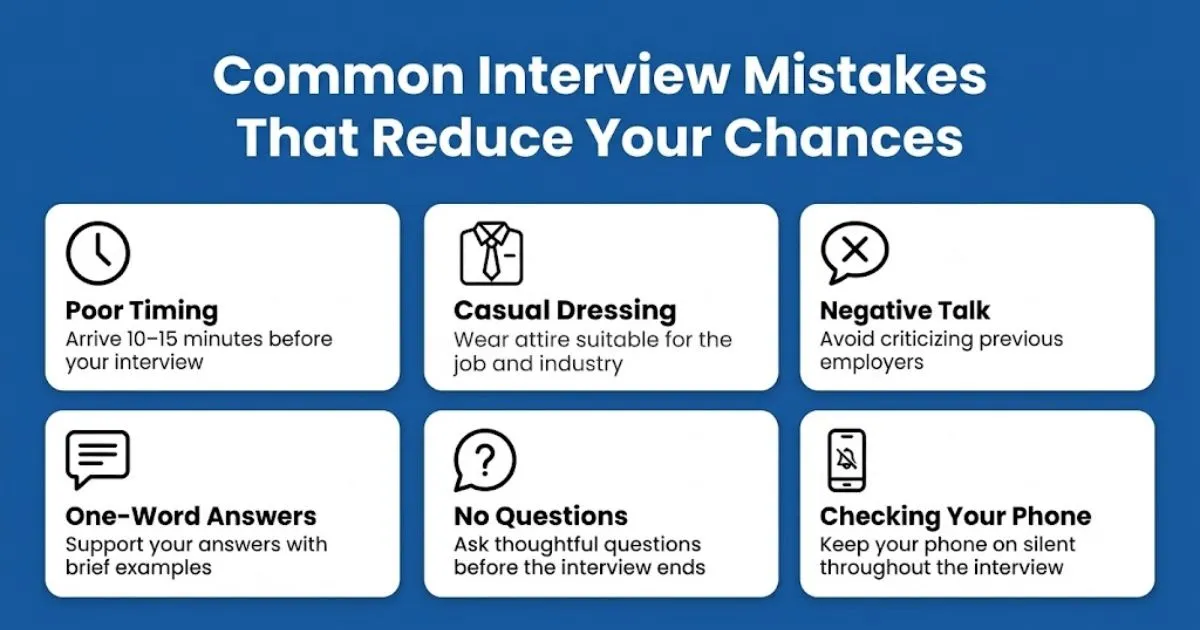
Many candidates lose good opportunities because of small, avoidable mistakes rather than a lack of qualifications. Here are the most common ones seen in interviews across Nepal.
1. Poor Timing
Arriving late or arriving too early without informing the receptionist can create a bad first impression. Both extremes suggest poor planning, so it is best to arrive 10 to 15 minutes before your scheduled time.
2. Dressing Too Casually
Dressing too casually for a formal environment, such as wearing jeans and slippers to a bank interview, signals a lack of seriousness. Always match your outfit to the industry you are interviewing for.
3. Speaking Negatively About a Previous Employer
Speaking negatively about a previous employer, even if the situation was genuinely difficult, makes interviewers uncomfortable. It also raises doubts about how you might speak about their company in the future.
4. Giving One-Word Answers
Giving very short, one-word answers without any explanation makes it hard for the interviewer to know you well. Always add a brief example or reason to support your answer.
5. Not Asking Any Questions
Not asking any questions at the end can suggest a lack of real interest in the position. Even one or two thoughtful questions can leave a stronger final impression.
6. Checking Your Phone
Checking your phone during the interview is one of the fastest ways to lose an opportunity, no matter how good your answers were. Switch it to silent mode before you walk in.
Body Language and Presentation Tips
How you present yourself matters almost as much as what you say. Here are key areas to focus on.
Eye contact: Maintain natural eye contact with the interviewer while speaking. It shows confidence and honesty, but avoid staring continuously, as that can feel intense.
Body language: Sit upright, keep your hands relaxed on your lap or the table, and avoid crossing your arms, which can look defensive. A small, genuine smile at the start helps put both you and the interviewer at ease.
Dressing professionally: Choose clean, ironed formal clothes suited to the industry. A bank or corporate office usually expects formal wear, while an NGO or IT company may allow smart-casual attire. When unsure, it is safer to dress slightly more formal than expected.
Communication skills: Speak clearly and at a moderate pace. It is completely fine to pause for a second to think before answering, rather than rushing and using filler words.
Confidence: Confidence comes mainly from preparation. Knowing your answers well, and practicing them beforehand, naturally makes you sound more confident on the actual day.
Punctuality: Being on time, or a few minutes early, is one of the simplest ways to show professionalism before you even say a word.
Good Answer vs Poor Answer
Conclusion
Interviews in Nepal, whether for a bank, a hospital, an IT company, or a government office, tend to test the same basic things: can you communicate clearly, do you understand the role, and will you fit into the workplace. Once you understand this pattern, preparation becomes much easier.
Practice the questions above, prepare real examples from your own life, and focus on presenting yourself honestly and confidently. With the right preparation, your next interview can feel far less stressful and much more like a normal conversation.
A great interview starts with the right skills and confidence. Join our HR Training program to learn practical recruitment, communication, and workplace skills that employers value.