

Job interviews can be nerve-wracking, especially when you're preparing for a competitive position in Nepal's job market. Whether you're a fresh graduate or looking to switch careers, completing the interview is crucial for landing your dream job. In this blog post, we'll cover essential job interview tips tailored to the context of Nepal, helping you make a lasting impression on potential employers.
This guide will take you through the entire interview process, from preparation to post-interview follow-up. We'll provide practical advice on how to present yourself, answer common questions, and handle tricky situations, all while keeping the Nepali work culture in mind. Let's dive in!
Table of Contents
- Understanding the Nepali Job Market
- The Importance of Job Interviews
- Common Interview Formats in Nepal
- Preparing for the Interview
- 1. Research the Company
- 2. Understand the Job Description
- 3. Practice Common Interview Questions
- Presenting Yourself Professionally
- Dress Appropriately
- Arrive on Time
- Body Language and Communication
- Answering Questions Effectively
- Highlighting Your Strengths
- Addressing Weaknesses
- Handling Difficult Questions
- Discussing Salary Expectations
- Addressing Gaps in Employment
- Post-Interview Etiquette
- Sending a Thank-You Email
- Following Up on the Interview
- Conclusion
Understanding the Nepali Job Market
The Importance of Job Interviews
In Nepal, job interviews are a critical part of the hiring process. Employers use interviews to assess your qualifications and personality, communication skills, and how well you fit within the company's culture. A well-prepared candidate who presents themselves confidently is more likely to succeed.
Interviews in Nepal often emphasize respect, humility, and a good understanding of the company's values. Being aware of these cultural nuances can give you an edge over other candidates.
Common Interview Formats in Nepal
In Nepal, job interviews can take various forms depending on the industry and the position you're applying for. Some of the common formats include,
- One-on-One Interviews: The most common type is meeting with a single interviewer.
- Panel Interviews: This involves multiple interviewers, often from different departments.
- Group Interviews: You and other candidates are interviewed together, usually for positions that require teamwork.
- Technical Interviews: Focuses on assessing your technical skills and problem-solving abilities, common in IT and engineering roles.
Understanding the format of your interview will help you prepare accordingly and tailor your approach to each situation.
Preparing for the Interview
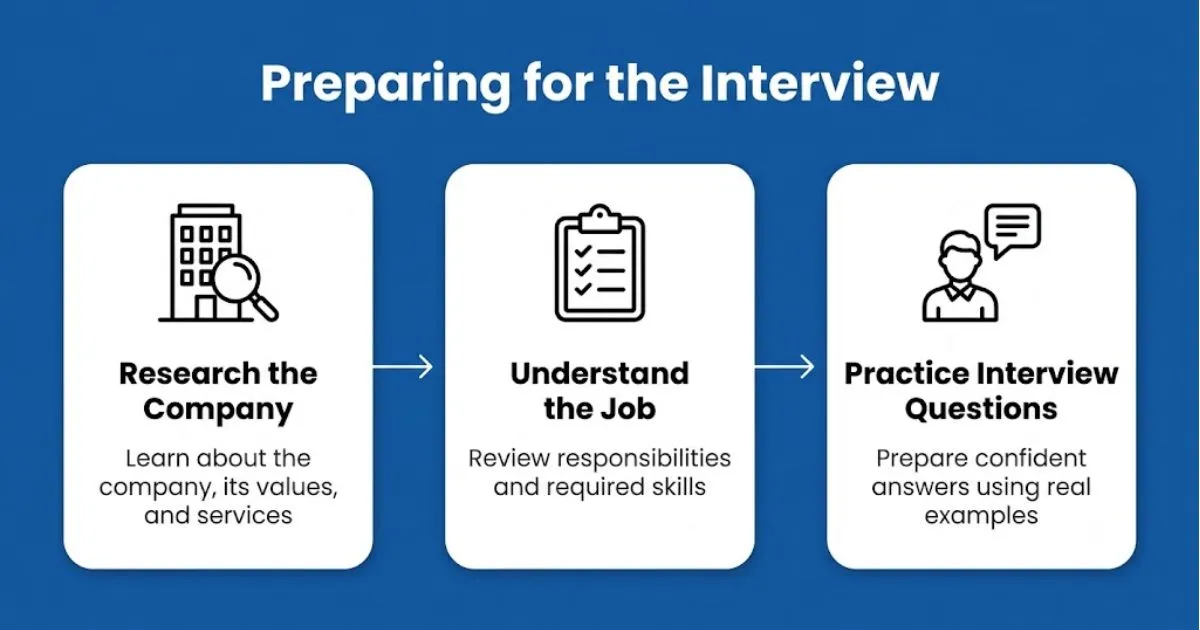
A successful interview starts before you enter the interview room. Taking time to prepare helps you answer questions with confidence, make a good first impression, and show employers that you are serious about the opportunity. The following steps can help you get ready for your interview and improve your chances of success.
1. Research the Company
One of the most important steps in preparing for a job interview is researching the company. Understanding the company's history, mission, values, and recent achievements will demonstrate to the interviewer that you are genuinely interested in the position.
Start by visiting the company's website and reading about its services, products, and team members. Check their social media profiles to get a sense of their corporate culture. If possible, talk to current or former employees to gain insider knowledge about the company.
2. Understand the Job Description
Thoroughly understanding the job description is crucial for tailoring your answers during the interview. Carefully review the required skills, qualifications, and responsibilities. Make a list of your experiences and accomplishments that match the job requirements.
Prepare specific examples that demonstrate your abilities in these areas. For instance, if the job requires strong leadership skills, think of a time when you successfully led a project or team.
3. Practice Common Interview Questions
While each interview is unique, some common questions are frequently asked in job interviews in Nepal. Practicing these questions will help you respond confidently and concisely.
Here are some examples:
- Tell me about yourself.
- Why do you want to work for our company?
- What are your strengths and weaknesses?
- Describe a challenging situation you faced and how you handled it.
- Where do you see yourself in five years?
When answering these questions, focus on providing clear, concise, and relevant responses. Use the STAR method (Situation, Task, Action, Result) to organize your answers when talking about past experiences.
Presenting Yourself Professionally
Dress Appropriately
In Nepal, how you present yourself during a job interview is crucial. Dressing appropriately shows respect for the interview process and the company. For most job interviews, formal attire is recommended.
For men, this typically means wearing a suit or dress shirt with trousers and polished shoes. Women should opt for a formal dress, a sari, or a kurta with a well-fitted blazer. Ensure that your clothes are clean, well-ironed, and comfortable.
In some industries, like creative fields or startups, business casual attire may be acceptable. However, if you're unsure, it's always safer to dress more formally.
Arrive on Time
Punctuality is highly valued in Nepali culture, and arriving late to a job interview can leave a negative impression. Plan your route, taking into account potential traffic delays. Aim to arrive at the interview location at least 10 to 15 minutes early.
Arriving early not only shows respect for the interviewer's time but also gives you a few minutes to compose yourself and review your notes.
Body Language and Communication
Your body language and communication style play a significant role in how you're perceived during an interview. In Nepal, being polite, respectful, and maintaining good eye contact is essential.
- Handshake: If a handshake is offered, ensure it is firm but not overpowering. In some cases, especially with elders, a slight bow or placing your hands together in a "Namaste" gesture is appropriate.
- Posture: Sit up straight, and avoid slouching or leaning too far back. Your posture should show confidence and attentiveness.
- Eye Contact: Maintain eye contact with the interviewer to show that you are engaged and confident. However, avoid staring, as it can be perceived as aggressive.
- Speaking Clearly: Speak clearly and calmly. Take your time to articulate your thoughts, and avoid using filler words like "um" or "like."
Answering Questions Effectively
Highlighting Your Strengths
During the interview, you'll likely be asked to discuss your strengths. This is your opportunity to showcase the skills and qualities that make you an ideal candidate for the job.
When discussing your strengths, focus on those that are directly related to the job. For example, if you're applying for a position that requires strong organizational skills, you might say, "One of my key strengths is my ability to stay organized and manage multiple tasks effectively. In my previous role, I successfully coordinated several projects simultaneously, ensuring that all deadlines were met."
Provide specific examples to back up your claims, and be honest about your strengths. Exaggerating or lying about your abilities can backfire if you're asked to provide evidence or if you're hired and unable to deliver.
Addressing Weaknesses
Talking about your weaknesses can be challenging, but it's important to approach this question with honesty and a focus on self-improvement. Employers aren't necessarily looking for a perfect candidate, but they do want someone who is aware of their limitations and is actively working to improve them.
When discussing a weakness, choose something that isn't crucial to the job and explain how you're working on it. For example, you might say, "One area I'm working on is public speaking." While I feel confident in one-on-one interactions, I sometimes get nervous when speaking in front of large groups.
To improve, I've started attending workshops and practicing in front of small groups. "This response shows that you recognize your weakness and are taking steps to improve, which can be seen as a positive trait.
Handling Difficult Questions
Discussing Salary Expectations
In Nepal, salary discussions can be a sensitive topic during interviews. If asked about your salary expectations, it's important to approach the question tactfully. Avoid stating a specific figure immediately, especially if you're unsure of the company's budget or salary range.
Instead, you could respond with, "I'm open to discussing a salary that is fair and reflective of my skills and experience. I'd like to learn more about the responsibilities of the role and the benefits package before discussing a specific salary.
This response shows that you're flexible and willing to negotiate based on the full compensation package.
Addressing Gaps in Employment
If you have gaps in your employment history, be prepared to discuss them during the interview. Gaps in your employment can happen for various reasons, such as continuing your education, personal health issues, or taking time off to care for your family.
When addressing employment gaps, be honest and focus on what you did during that time to stay productive or improve your skills. For example, you might say, "During my time away from full-time work, I completed several online courses to enhance my skills in digital marketing. This experience has made me even more prepared for this role."
This approach helps reassure the employer that you remain committed to your professional growth, even during periods of unemployment.
Post-Interview Etiquette
Sending a Thank-You Email
After the interview, it's a good practice to send a thank-you email to the interviewer. This small gesture can significantly impact you by leaving a positive impression and showing your professionalism.
In your email, express your gratitude for the opportunity to interview, reiterate your interest in the position, and briefly mention something specific that was discussed during the interview. For example, "Thank you for taking the time to meet with me today.
I enjoyed learning more about [Company Name] and the exciting opportunities within the [Department Name]. I am very interested in the [Job Title] position and believe my skills in [specific skill] would be a great fit for your team."
Keep the email brief and to the point, and send it within 24 hours of the interview.
Following Up on the Interview
If you haven't heard back from the employer within the timeframe they mentioned, it's appropriate to follow up politely. Following up shows that you're still interested in the position and keeps you on the employer's radar.
You can send a brief email or make a phone call to check on the status of your application. For example, you might say, "I wanted to follow up on my application for the [Job Title] position."I remain very interested in the opportunity and would appreciate any updates on the hiring process."
Conclusion
Acing a job interview in Nepal requires preparation, professionalism, and an understanding of cultural nuances. By researching the company, practicing common questions, presenting yourself well, and following up appropriately, you can increase your chances of success.
Remember that every interview is an opportunity to learn and improve, If you have a problem finding a job then go to our site and find various Job categories.