

A Section Officer (Sakha Adhikrit) is a respected government post in Nepal’s civil service under the Gazetted Third Class Officer (रा.प. तृतीय श्रेणी) category. This job comes with a fixed government salary along with allowances and benefits, which together make up the monthly income. The salary also increases over time through regular increments.
In this guide, we will cover the Section Officer salary in Nepal, including pay scale and allowances, along with the process of becoming a Section Officer.
Table of Contents
- Role of a Section Officer
- Basic Salary of a Section Officer in Nepal
- Starting Salary Amount
- Deductions from Salary
- Allowances and Benefits for Section Officers
- 1. Dearness Allowance (Mahangi Bhatta)
- 2. Festival Allowances (Dashain/Tihar Bonus)
- 3. Dress Allowance
- 4. Medical Expenses and Health Benefits
- 5. Child Care Allowance
- 6. Remote Area, Field, and Local Allowances
- 7. Communication and Other Specific Allowances
- Long-Term Benefits and Retirement Support
- 1. Pension Scheme
- 2. Gratuity and Provident Fund
- 3. Health and Social Security After Retirement
- Career Progression and Salary Growth
- Salary Comparison with other Government Positions
- How to Become Section Officer in Nepal
- Eligibility Criteria
- The Lok Sewa Aayog Exam
- Starting the Career
- Conclusion
Role of a Section Officer
Section Officers work in different government ministries and departments. They handle important office tasks like preparing reports, managing files, arranging documents, and supporting daily office work. They also supervise a small team and make sure all work is done properly and on time.
They also act as a link between senior officers and junior staff. Section Officers help to turn government decisions into action at the office level. Their work helps improve coordination, keep office work organized, and make government services run smoothly and effectively.
Basic Salary of a Section Officer in Nepal
Starting Salary Amount
For the latest fiscal year, the basic salary of a Section Officer is approximately NPR 47,208 per month. This amount, known as the Talab Scale (तलब स्केल), is the foundation of their income. However, this is not the actual money they receive at the end of the month. The basic salary only acts as a starting figure because deductions are made from it, and allowances are added later, which changes the final amount received.
Deductions from Salary
From this basic salary, certain deductions are made every month. The first deduction is for the Provident Fund (PF), where a small part of the salary is kept aside as savings, and the government also adds money to it. This helps employees build a secure fund for the future, especially after retirement. The second deduction is the Social Security Tax, which is collected to support Nepal’s social security system. These deductions slightly reduce the take-home pay, but they are beneficial because they give long-term financial security and stability.
Allowances and Benefits for Section Officers
Section Officers in Nepal receive several types of allowances along with their basic salary. These extra payments help increase monthly income, support daily expenses, and make government jobs more stable and financially secure.
1. Dearness Allowance (Mahangi Bhatta)
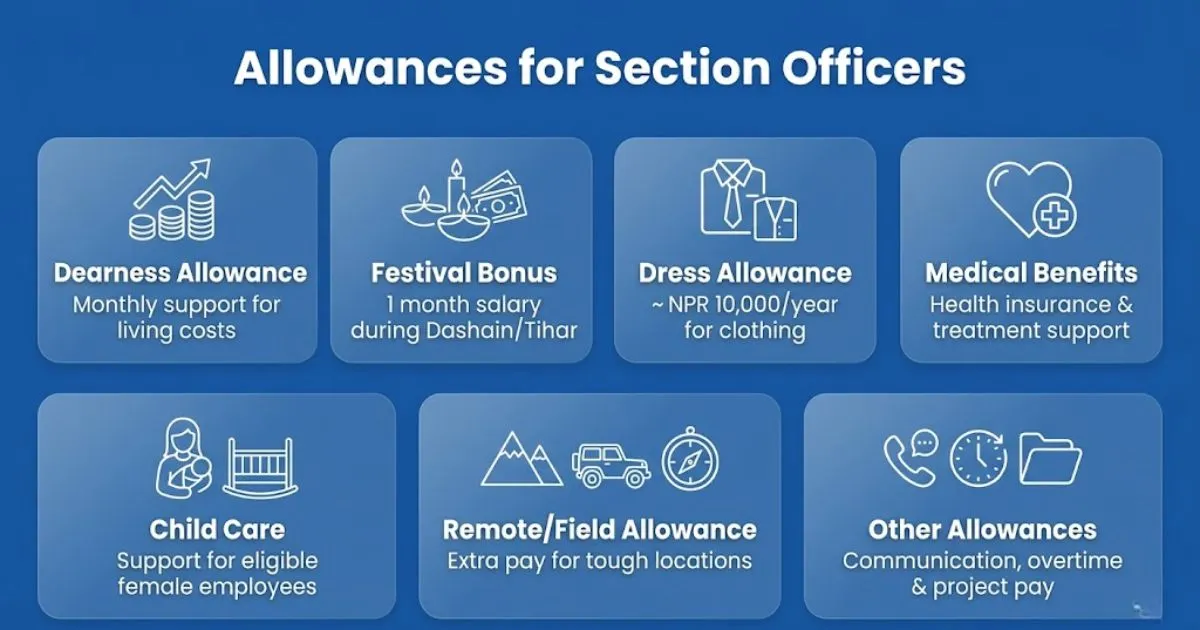
Section Officers get extra money called Dearness Allowance or Mahangi Bhatta to help with the increasing cost of living. This allowance is added to the basic salary every month. It helps officers buy food, clothes, pay rent, and meet other daily expenses. For the fiscal year 2082/83, this allowance is about NPR 2,000 per month. While it may not cover all price increases, it helps employees manage their daily life without financial stress. This allowance is part of the regular monthly salary, so it provides a steady extra income.
2. Festival Allowances (Dashain/Tihar Bonus)
During big festivals like Dashain and Tihar, Section Officers receive a festival bonus. This bonus is usually equal to one month’s basic salary and is given just before Dashain. The purpose of this allowance is to help employees prepare for festival celebrations, buy clothes, gifts, and enjoy with their families. Festivals are very important in Nepal, and this bonus ensures that officers can celebrate without worrying about money. It is a very useful allowance that supports family and cultural life.
3. Dress Allowance
Every year, Section Officers get a dress allowance of about NPR 10,000. This money is used to buy official clothes and uniforms for work. It helps officers stay professional and presentable during meetings, official programs, and public events. The dress allowance ensures that employees do not need to spend their own money to buy work clothes. It is paid once a year and helps employees always have proper attire for their official duties.
4. Medical Expenses and Health Benefits
Section Officers and their families get health insurance from the government. This insurance pays for hospital visits, medicines, and other medical needs. Sometimes, if the medical bills are higher than what the insurance covers, employees can get extra reimbursement from the government. This means they do not have to pay large medical bills from their own pocket. Health benefits give officers peace of mind because they know their health and their family’s health is taken care of.
5. Child Care Allowance
Some female employees can get a child care allowance, but it is not for everyone. This allowance depends on the officer’s job, position, and eligibility. It helps mothers cover the cost of taking care of young children, including daycare, food, and other child-related expenses. This allowance supports female employees to balance their work and family responsibilities, especially during the early years of their children. It is less common than other allowances but very useful for women working in civil service.
6. Remote Area, Field, and Local Allowances
Section Officers who work in remote or difficult areas get extra pay called Durgam Kshetra Bhatta. The amount depends on how far or difficult the area is. Officers who travel a lot for their work also get field allowances to cover transportation, meals, and other expenses. These allowances help employees work in tough areas without worrying about extra costs. They make it possible for officers to do their job comfortably even in remote or challenging locations.
7. Communication and Other Specific Allowances
Section Officers may also get communication allowances to cover mobile phone or internet bills. Some officers can also get overtime pay if they work extra hours, or project-specific allowances if they are assigned to special government projects. The amount and availability of these allowances depend on the ministry or department. These extra allowances make the total salary bigger and help employees manage work that requires extra effort.
Long-Term Benefits and Retirement Support
Section Officers in Nepal also get long-term benefits and retirement support. These benefits help them after retirement and make sure they can live a secure life without financial problems after leaving government service.
1. Pension Scheme
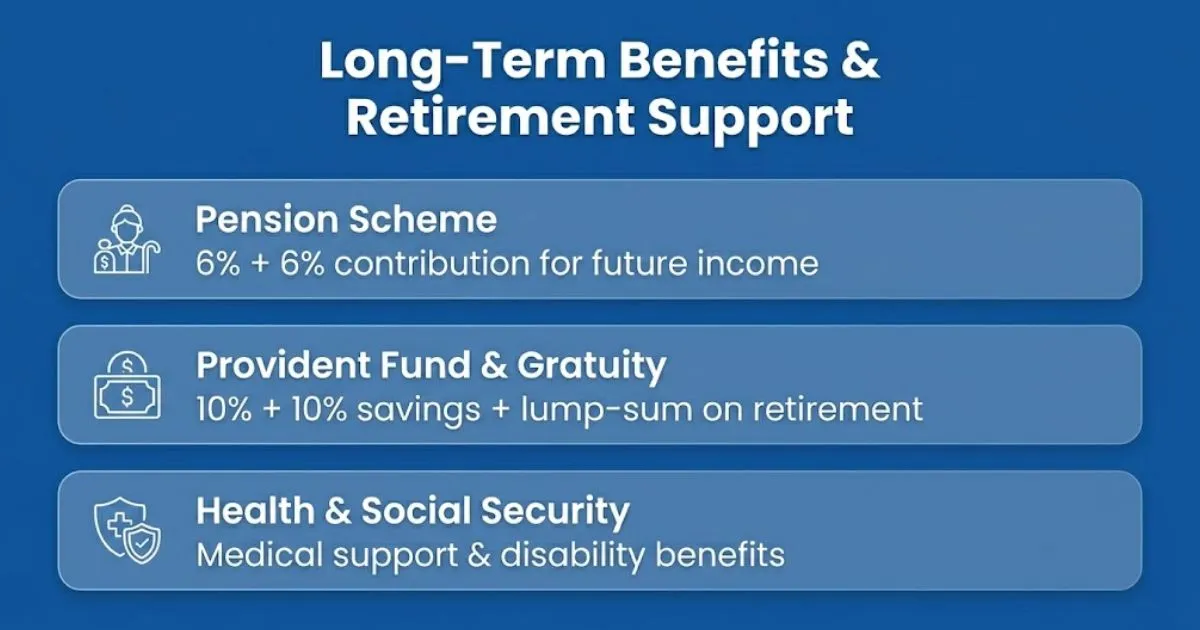
Section Officers in Nepal get a pension to make sure they have money even after they retire. This is a contribution-based system managed by the Samajik Suraksha Kosh (SSF). Every month, 6% of the employee’s basic salary is taken and added to their pension fund. At the same time, the government adds the same amount, 6%, to the fund. Over time, this money grows, and when the officer retires, they receive regular payments from this fund. This helps retired employees live comfortably without worrying about money. The pension system gives a secure and steady income after leaving the job, so employees can feel safe about their future.
2. Gratuity and Provident Fund
Section Officers also get financial benefits from Gratuity and the Provident Fund. Every month, 10% of their basic salary is deducted and saved in the Karmachari Sanchaya Kosh (KSK). The government also adds another 10% to this fund. This money earns interest over time, which makes the total amount grow even more. Employees can also take a loan from this fund if they need extra money for important expenses.
Gratuity, called Upadan, is a lump-sum payment given to employees when they retire. It is calculated based on how many years they worked and the last salary they received. Together, the Provident Fund and Gratuity make sure Section Officers have a strong financial backup after they leave government service. These benefits help employees plan for their future and live without money worries after retirement.
3. Health and Social Security After Retirement
Even after retiring, Section Officers continue to get health benefits and social security. These benefits are connected to the pension system, so retirees can get medical services without paying large amounts of money themselves.
In addition, employees who face work-related disabilities may get a disability pension. This means if an officer is hurt or cannot work because of their job, they will still get money support from the government. These long-term benefits give Section Officers confidence and peace of mind because they know their future and health will be taken care of even after they stop working.
Career Progression and Salary Growth
Section Officers can get promoted to higher posts like Under Secretary (Upa Sachiv). Promotion depends on how well an officer performs in their job, how many years they have served, and internal exams for government employees. Regular performance reviews (karyasampadan mulyankan) are also used in the process. Higher education like a Master’s degree and training from Nepal Administrative Staff College (NASC) can also support faster promotion by improving skills, knowledge, and job performance.
Salary increases gradually throughout the job. At the beginning, Section Officers receive a basic salary along with allowances such as Mahangi Bhatta, festival bonus, and dress allowance. With yearly increments and grade increases, the total income slowly grows over time. After promotion to Under Secretary, both salary and allowances increase again, leading to a higher and more stable income in the long run.
Salary Comparison with other Government Positions
Here is a detailed comparison of the salary of Section Officer with other government positions in Nepal. It shows how salary varies across different job levels in the civil service system.
How to Become Section Officer in Nepal
You can become a Section Officer in Nepal by meeting the required eligibility and passing the Lok Sewa Aayog (Public Service Commission) exam. It is a competitive process that selects candidates for government administrative posts based on merit, knowledge, and skills.
Eligibility Criteria
To become a Section Officer in Nepal, you need to meet some important rules. First, you must be a Nepali citizen. This means you should have Nepali nationality. Second, your age should usually be between 21 and 35 years. Some special groups, like people from certain communities or government employees, may get extra age relaxation. Third, you must have finished at least a Bachelor’s degree from a recognized university. This shows that you have enough education and knowledge to work in the government. Meeting these requirements is the first step to becoming a Section Officer.
The Lok Sewa Aayog Exam
To become a Section Officer, you have to pass a competitive exam by the Lok Sewa Aayog (Public Service Commission). This exam has three main steps:
1. Written Examination
The first step is a written exam. In this test, you are asked questions about general knowledge, government rules and systems, and current events in Nepal and the world. This exam checks how much you know about society, government, and public administration. Doing well in this step is very important because only good candidates move to the next stage.
2. Practical Test or Group Discussion
The second step is a practical test or a group discussion. This step checks how well you can solve real work problems, work with others in a team, and share your ideas clearly. It also looks at how you act in group situations and how confident you are in giving answers.
3. Final Interview
The last step is a personal interview. In this step, officials ask questions to see your personality, communication skills, confidence, and understanding of government work. The interview makes sure that only capable and honest candidates are chosen for the job.
Starting the Career
After passing all three steps—the written exam, practical test or group discussion, and final interview—you are officially selected as a Section Officer. Once you join, you start a respected and secure career in the Nepal government. You get a good salary, benefits, and chances to grow in your job over time. Being a Section Officer is considered an important and trusted position in the government.
Conclusion
Becoming a Section Officer in Nepal is a stable and respected government job. It offers strong job security, social respect, and regular salary growth through increments and promotions. Officers also receive long-term benefits like pension, provident fund, and health insurance, which support them after retirement.
However, the starting salary is relatively low compared to some private jobs, and the work can include rules, paperwork, and delays. Still, it is a good career option for those who want stability, respect, and steady growth in the government sector.