

Government jobs in Nepal are well-liked because they provide stability, respect, and financial security. Among them, the Nayab Subba, also known as Non-Gazetted First Class staff, plays an important role in the smooth running of government offices. For people preparing for Lok Sewa exams, it is useful to know the exact salary, allowances, and benefits of this position. In this guide, we explain the basic pay, different allowances, deductions, and the final take-home salary of a Nayab Subba as per the latest government budget.
Table of Contents
- Understanding the Nayab Subba Position in Nepal
- What is a Nayab Subba?
- Where Does a Subba Fit in the Government Structure?
- How to Become a Nayab Subba
- The Official Basic Salary of a Nayab Subba
- Current Basic Pay for a New Nayab Subba
- How Your Salary Grows Every Year (The Grade System)
- Recent Salary Updates from the Nepal Budget
- Allowances and Benefits for Nayab Subba
- 1. Inflation Allowance (Mahangi Bhatta)
- 2. Travel Allowance for Work
- 3. Dashain Bonus (Festival Expense Allowance)
- 4. Housing and Location-Based Allowances
- 5. Health and Medical Benefits
- 6. Uniform/Clothing Allowance
- How the Economy Affects Your Salary
- The Challenge of Rising Prices (Inflation)
- How the Government Helps with Inflation (Mahangi Bhatta)
- Career Growth Opportunities for Nayab Subba
- Conclusion
Understanding the Nayab Subba Position in Nepal
What is a Nayab Subba?
A Nayab Subba is a government worker at the Non-Gazetted First Class level, called Rajpatra Anankit Pratham Shreni in Nepali. This job is very important because Nayab Subbas help government offices work properly. They do many tasks like preparing reports, managing files, helping different departments work together, and assisting citizens with government services. They also act as a connection between junior staff and higher officers. Without Nayab Subbas, daily office work would be slow, and public services would not be done on time.
Where Does a Subba Fit in the Government Structure?
In Nepal’s civil service, Nayab Subbas are in the middle level. They are above Kharidars (Non-Gazetted Second Class) and below Section Officers (Gazetted Third Class or Sakha Adhikrit). This makes the job stable and respected. Nayab Subbas can gain experience and later get promoted to Section Officers. This means the job is a good starting point for a long-term career in government.
How to Become a Nayab Subba
To become a Nayab Subba, a person must complete +2 level (Intermediate) education or something similar. After that, they must pass the competitive exam by the Public Service Commission (Lok Sewa Aayog). The exam has two parts. First, a written test with questions about general knowledge, language, mathematics, and government work. Second, an interview to check communication skills, personality, and understanding of administrative tasks. Those who pass may also get short training before starting the job. The process is competitive, but it gives a safe and respected government job with chances to grow and get promoted.
The Official Basic Salary of a Nayab Subba
Current Basic Pay for a New Nayab Subba
According to the Nepal Government Pay Scale, a newly appointed Nayab Subba gets a basic salary of approximately NPR 34,730 per month. This is the official starting salary for anyone entering this job in Nepal. The basic salary is set by the government and does not include extra allowances or deductions. It is the main part of a Subba’s monthly pay and is used as the base to calculate total earnings, including all allowances and benefits.
How Your Salary Grows Every Year (The Grade System)
Government employees, including Nayab Subbas, receive an annual increment called Grade Briddhi. Each year, one grade is added to the basic salary. This means that the longer a Subba works, the more their salary increases. The grade system is a way to reward experience and years of service. It makes the job more attractive and encourages employees to continue working in government.
Here is the salary structure of Nayab Subba based on grade levels:
Recent Salary Updates from the Nepal Budget
In the fiscal year 2082/2083 budget, the government kept the existing pay scale for Nayab Subbas. There was no major increase in the basic salary, but allowances were updated to help employees deal with rising living costs. This means that while the basic salary grows slowly with grades, the total pay including allowances remains fair and dependable. The combination of steady grade increments and updated allowances ensures that government jobs continue to give a stable and reliable income, keeping them attractive compared to jobs in other sectors.
Allowances and Benefits for Nayab Subba
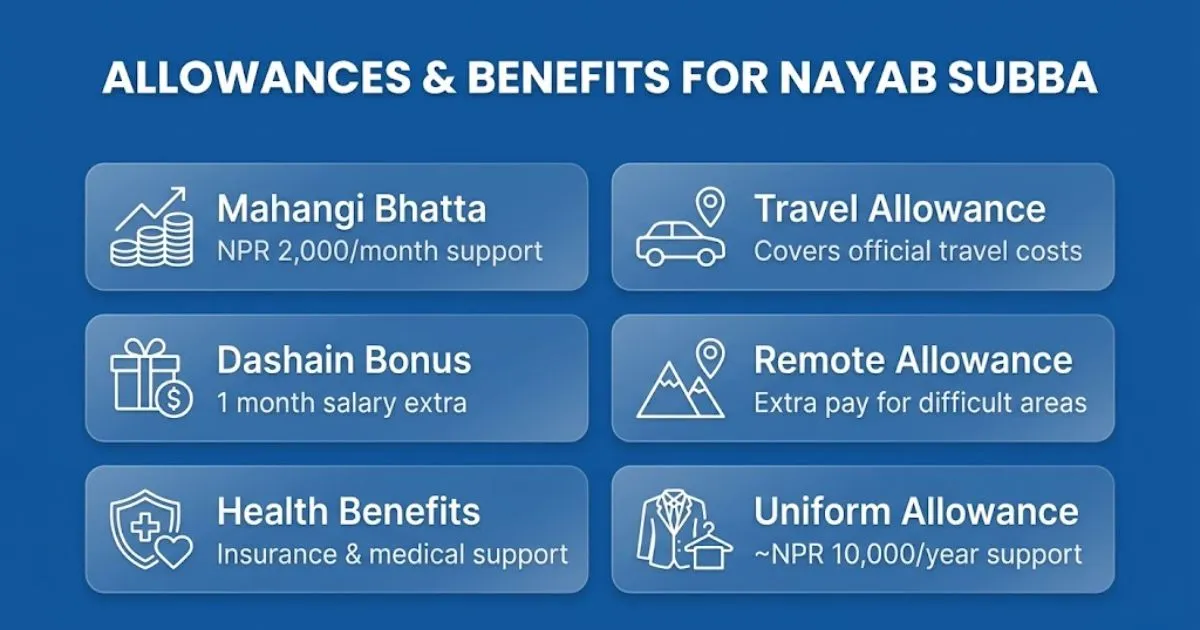
Nayab Subba employees in Nepal get extra allowances along with their basic salary. These benefits help them manage daily expenses, travel costs, and work needs. They also get support for festivals, health care, and clothing. Overall, these allowances make government jobs more secure and help employees live a better and stress-free life.
1. Inflation Allowance (Mahangi Bhatta)
Every Nayab Subba gets NPR 2,000 per month as Mahangi Bhatta. This allowance is given to help employees manage the rising cost of living. Prices of food, fuel, transport, and other daily needs go up over time. This allowance helps employees handle these extra costs and makes it easier to live comfortably. It is paid every month and adds to the main salary, helping employees maintain a steady lifestyle.
2. Travel Allowance for Work
Nayab Subbas gets a travel allowance for work-related trips. Depending on the posting and the type of work, this can be a fixed monthly amount or reimbursement for actual travel expenses. This allowance helps cover the cost of traveling between offices, visiting districts, attending meetings, or doing fieldwork. It makes sure that employees are not paying out of their own pocket while performing official duties.
3. Dashain Bonus (Festival Expense Allowance)
Every year, Nayab Subbas receive a bonus equal to one month’s basic salary before Dashain, which is the biggest festival in Nepal. This bonus helps employees and their families celebrate the festival without worrying about extra expenses. They can use it to buy food, gifts, clothes, and other festival items. The Dashain bonus makes it easier for families to enjoy the festival comfortably.
4. Housing and Location-Based Allowances
Not all Nayab Subbas get a housing allowance. However, those posted in remote or difficult areas (durgham kshetra) receive a hardship allowance. This extra pay is given because living and working in these areas is challenging. These places often lack basic facilities like schools, hospitals, and markets. The allowance helps employees manage extra costs and encourages them to take jobs in remote or difficult locations.
5. Health and Medical Benefits
Nayab Subbas are included in the government health insurance scheme, where the government pays a large part of the insurance premium. This helps employees and their families get medical treatment and hospital care at low costs. It reduces the financial stress of health problems and ensures that employees and their families stay healthy. Health benefits make government jobs safer and more secure for employees.
6. Uniform/Clothing Allowance
Nayab Subbas also gets a uniform allowance, usually around NPR 10,000 per year. This allowance is meant to cover the cost of official uniforms and other work-related clothing. It helps employees maintain a professional look and stay neat while working. The money can also be used to replace uniforms when they wear out, so employees do not have to spend their own money on official clothing.
How the Economy Affects Your Salary
The Challenge of Rising Prices (Inflation)
Inflation is when prices of everyday things like food, fuel, transport, and services keep going up. This affects everyone, including government employees. Even if your basic salary stays the same, it can buy less over time because things cost more. For example, if rice, vegetables, or fuel become more expensive, your fixed salary does not stretch as far as before. This is why inflation can reduce the real value of your salary, making it harder to manage daily expenses if there are no adjustments.
How the Government Helps with Inflation (Mahangi Bhatta)
To help employees handle inflation, the government gives Mahangi Bhatta (inflation allowance). This is extra money added to the monthly salary, helping employees cover the rising cost of living. In addition, the government reviews and updates the salary scale every year through the annual budget. These steps make sure that Nayab Subbas and other civil servants can maintain a good standard of living, even when prices rise. Together, the allowance and salary revisions help employees keep their salary useful and enough to meet daily needs.
Career Growth Opportunities for Nayab Subba
Being a Nayab Subba is not just about a fixed salary. This job also gives many chances to grow in the government. The first promotion is usually to Section Officer (Sakha Adhikrit). This means more work responsibility, higher pay, and the chance to manage other staff. Promotions happen based on how many years you have worked, your performance, and sometimes exams. Even if a Subba is not promoted, they still get annual grade increases, which slowly raise their salary. Experienced Subbas can also get special roles in areas like finance, auditing, or managing government projects. These roles may give extra allowances and help with future promotions.
In the long run, a Nayab Subba can grow to higher positions like Under-Secretary or director-level jobs in government ministries. Attending training programs, workshops, and seminars helps Subbas learn new skills, which can make it easier to get promotions. Overall, the Nayab Subba job provides job security, respect, skill development, and better pay over time, making it a strong and reliable career in the government.
Conclusion
Being a Nayab Subba is not just a regular job in nepal. It is a stable and respected career in Nepal. The salary, together with allowances like Mahangi Bhatta for inflation, travel and field pay, festival bonuses, and health benefits, makes the total income attractive. Subbas also get annual grade increases, which slowly increase their salary every year.
This job also provides strong career growth opportunities over time. Nayab Subbas can be promoted to Section Officer and higher posts with experience. They also receive training and workshops to improve their skills. Even with rising prices, salary updates and allowances help maintain a stable life. Overall, it is a secure and respected job with good pay and long-term growth in Nepal.