

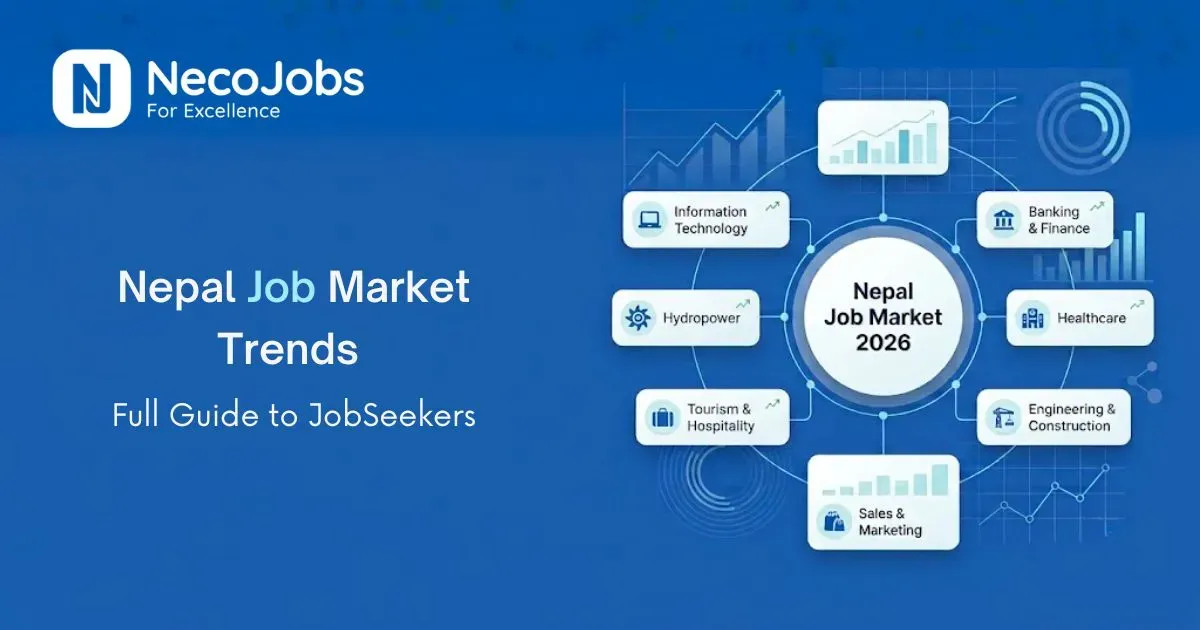
If you are a student, a fresh graduate, or a working professional in Nepal, you have probably asked yourself one question this year. Is it getting easier or harder to find a good job in Nepal?
The honest answer is: it depends on where you look. Nepal's job market in 2026 is not one single story. Some sectors, like IT and hydropower, are growing fast. Others, like tourism, are recovering but in an uneven way. The wider economy is also going through a difficult stretch, still adjusting after the political changes of late 2025 and slower global growth in 2026.
In this guide, you'll learn about the latest job market trends in Nepal, the industry's hiring, and practical tips to improve your chances of getting hired.
What the Employment Data Actually Shows
Understanding Nepal's job market starts with looking at the latest employment data. While different government surveys report slightly different figures, they all point to the same overall picture: finding a formal job remains challenging, especially for young people.
- The last full nationwide labour survey put the unemployment rate at 11.4%.
- A more recent living standards survey found unemployment closer to 12.6%, with a broader measure of unemployed and inactive people reaching almost a quarter of the population.
- Youth unemployment has stayed above 20% for years now, among the highest in South Asia.
- Around 84 to 85% of all jobs in Nepal are informal. That means most workers don't have a formal contract, fixed salary, or social security coverage.
- A new nationwide labour survey is currently underway and will run until March 2027. Until it wraps up, any "2026 unemployment rate" you see floating around online is really still based on older data.
Sectors Creating Job Opportunities in 2026
Not every sector in Nepal is moving in the same direction. Here's an honest look at where jobs are actually opening up, and where things are harder.
1. Information Technology (IT) and Software Services
The IT sector is one of Nepal's fastest-growing industries. IT service exports reached an estimated USD 1 billion, around Rs. 145 billion, in 2025, more than double what they were in 2022. The sector is growing at roughly 18 to 20% a year, and employment has grown from about 70,000 professionals in 2022 to around 100,000 today, spread across more than 6,000 registered IT and BPO firms.
- Jobs available: software development, web and mobile app development, quality testing, UI/UX design, cloud and DevOps engineering, cybersecurity, data analytics, healthcare data processing for US clients, and financial back-office work for Australian clients.
- Skills employers want: real coding ability, not just a degree, cloud platform knowledge, good English communication, and comfort using AI tools at work.
- Growth outlook: strong and still growing, though a large number of ICT graduates leave the country within two years for better pay abroad, which is a real risk to keeping this momentum going.
- Who benefits: IT and computer science graduates, self-taught developers with a strong project portfolio, and anyone willing to build real projects instead of relying on a degree alone.
2. Hydropower and Energy
Hydropower is one of the more stable long-term sectors, supported by cross-border power trade deals and a growing pipeline of new projects. This is one of the sectors expected to drive Nepal's growth recovery from FY27 onward.
- Jobs available: civil and electrical engineering, project management, technical operations, and skilled trade work tied to plant construction and maintenance.
- Skills employers want: engineering qualifications, technical certificates, and project execution experience.
- Growth outlook: stable to growing, closely tied to infrastructure investment.
- Who benefits: engineering graduates and skilled technical workers, especially those based near project sites outside Kathmandu.
3. Tourism and Hospitality
Tourism is recovering, but not smoothly. Nepal welcomed about 1.16 million tourists in 2025, a rise of less than 1%, still around 3% below pre-pandemic levels. Early 2026 looked promising, with January arrivals up 15.7% and February crossing 100,000 monthly arrivals for the first time in years. But by April 2026, arrivals had fallen for two months in a row, down 7.3% year on year, mostly due to global flight disruptions tied to the Middle East conflict, since many international travelers connect through Gulf hubs on their way to Nepal.
- Jobs available: hotel and resort staff, trekking guides, travel agencies, restaurants, and transport services.
- Skills employers want: language skills, good customer service, and digital marketing knowledge for hotels and travel businesses.
- Growth outlook: mixed. Recovering over the medium term, but sensitive to global travel disruptions.
- Who benefits: hospitality graduates, people who speak multiple languages, and those in tourism cities like Kathmandu and Pokhara.
4. Banking, Finance, and Insurance
Banks remain one of the more reliable places for fresh graduates to get hired, especially BBA and BBS holders. But credit growth has stayed slow, reflecting cautious lending during a period of low private-sector confidence.
- Jobs available: banking associates, loan officers, insurance analysts, actuarial trainees, and compliance roles.
- Skills employers want: strong number skills, Excel and financial modeling, and professional certificates, especially for actuarial and finance-specialist roles.
- Growth outlook: stable, but hiring speed depends on overall credit growth, which has been slow.
- Who benefits: business and finance graduates, and anyone working toward professional certificates alongside their degree.
5. Construction and Infrastructure
Reconstruction after the September 2025 unrest, along with ongoing hydropower-linked construction, is expected to keep this sector busy into FY27.
- Jobs available: civil engineers, site supervisors, skilled labourers, and project coordinators.
- Skills employers want: technical or vocational training, safety certificates, and project management experience.
- Growth outlook: expected to strengthen from FY27 onward as reconstruction and government spending pick up.
- Who benefits: engineering graduates and vocational or technical training graduates.
6. E-commerce, Digital Marketing, and Digital Payments
Digital payment use, think QR codes and mobile wallets, has grown fast. This is creating demand for related digital jobs, even though e-commerce delivery and logistics still face real infrastructure challenges.
- Jobs available: digital marketing executives, social media managers, e-commerce operations staff, and fintech or payments roles.
- Skills employers want: SEO, paid ads, content creation, basic analytics, and platform management.
- Growth outlook: growing steadily, tied to the wider digital economy expansion.
- Who benefits: marketing graduates and self-taught digital marketers who can show a real portfolio of past campaigns or content.
7. Freelancing and Remote Digital Work
This isn't a formal "sector" in official statistics, but it's a real and growing way that Nepalis, especially young professionals, earn money. Freelance income through platforms like Upwork and Fiverr is treated as foreign digital service income and taxed at a flat 5% when it comes through Nepali banking channels. This kind of work is closely tied to the same skills fueling the IT export boom.
Sectors Facing More Pressure
Not everything is growing. Private-sector hiring overall remains weak, since business confidence hasn't fully recovered even though the big-picture economic numbers look stable. Agriculture, which still employs close to three-fifths of Nepal's economically active population, is a big part of the economy but offers few formal, well-paying jobs. Most agricultural work stays informal and low-income. It's a good reminder that a large share of Nepal's workforce is still stuck in low-productivity, informal work, no matter what the headline growth numbers say.
In-Demand Jobs and Skills in Nepal 2026
Based on current hiring patterns, these roles show consistently stronger demand:
- IT and software: web and mobile developers, QA engineers, DevOps and cloud engineers
- Data and analytics: data analysts, business intelligence roles, mostly inside IT/BPO and banking companies
- Digital marketing: SEO specialists, performance marketers, content creators
- Sales and business development: across banking, insurance, and FMCG companies
- Accounting and finance: accountants, financial analysts, actuarial trainees
- Engineering: civil and electrical engineers, mainly for hydropower and construction
- Healthcare: nurses, lab technicians, and allied health roles, driven by both local hospital growth and foreign employment demand
- Hospitality: hotel operations and guest service roles, tied to tourism recovery
- Skilled technical trades: electricians, plant technicians, machine operators
Skills Employers Increasingly Value
No matter the industry, a few skills come up again and again in what employers actually expect:
- Digital literacy. Basic comfort with computers, spreadsheets, and business software.
- Communication skills, including professional English. This matters most for IT, BPO, and roles that deal with international clients.
- Problem-solving and adaptability. Many Nepali companies are small, so employees are expected to handle different kinds of tasks.
- Technical or role-specific skills that fit the actual job, like coding, financial modeling, or engineering tools.
- Data literacy. The ability to read and use basic data, even in jobs that aren't data-focused.
- AI literacy. Knowing how to use AI tools to work faster, mostly relevant in IT, marketing, and content work. It's not a requirement in every job.
- Practical, proven experience. Internships or real projects, which recruiters are weighing more heavily than the degree alone.
Keep this in mind: not every job in Nepal needs AI skills or advanced technology. A construction site supervisor and a bank teller need very different skills than a software developer. Skill demand changes a lot by industry, so job seekers should focus on what's actually relevant to their target role instead of trying to learn everything at once.
Salary and Pay Trends in 2026
Let's talk numbers, because this is usually what people actually want to know. Pay in Nepal still depends heavily on our industry, our city, and how much we can prove we're worth in an interview. Here's a realistic picture of what people are actually earning in 2026, not the inflated figures we sometimes see in job ads.
What Job Seekers Should Expect in 2026
The market doesn't treat everyone the same way. Where we stand in our career decides what actually works for us in 2026, so it helps to break this down by experience level.
Entry-Level Job Seekers
Getting a first job in Nepal isn't necessarily easier in 2026, but the path forward has become clearer, especially in IT and digital-related fields. Here's what actually matters right now:
- Degree alone: Getting a degree alone is often not enough anymore. Employers, especially in tech and marketing, want proof of skill, such as a working app, a portfolio, or a real project, not just a transcript.
- Internships: Internships genuinely count as experience. A three-month internship or a solid final-year project is often treated by recruiters as equal to entry-level experience.
- Communication skills: Communication skills matter from the start. Many hiring managers reject CVs at the first stage based on basic written English and clarity, not technical skill alone.
- CV and interview prep: Good CV and interview preparation makes a real difference. A CV tailored and sent to fewer, better-matched jobs tends to work better than applying to every single listing.
- Competition: Competition is real, but not spread evenly. IT, digital marketing, and skilled technical roles currently have more openings compared to applicants than general admin or "any graduate" roles, where competition stays very high.
Experienced Professionals
For professionals a few years into their careers, the market clearly rewards specialization more than before.
- Specialized skills: Specialized skills, things like cloud architecture, financial modeling, project delivery, or digital campaign results, matter more than years of experience alone.
- Switching jobs: Switching jobs remains a common way to get a meaningful pay raise, especially in IT and finance, where skill-based pay gaps are getting wider.
- Salary negotiation: Salary negotiation works better with data. Professionals who research actual market rates for their role, instead of relying on their company's internal pay scale, tend to negotiate more successfully.
- Upskilling: Upskilling matters most in AI-related tools, cloud platforms, and data skills, since these are the areas where pay is growing the fastest.
- Leadership skills: Leadership skills become more valuable as companies grow, especially in the expanding IT and BPO sector.
- Industry-specific experience: Industry-specific experience, things like healthcare data processing, financial services outsourcing, or hydropower project management, is valued highly, since Nepal's export-focused service sectors are built around specific client industries.
AI and Technology's Impact on Nepal's Job Market
AI is a real part of the conversation in Nepal's job market in 2026. But so far, its main impact is changing how work gets done, not taking away large numbers of jobs.
Nepal released a National AI Policy in 2025, along with a broader "IT Decade Vision" plan to expand digital infrastructure, build AI skills, and set up AI Excellence Centers across provinces. In IT and BPO companies, AI is mostly used as a productivity tool, helping with coding, content writing, and repetitive back-office tasks, not replacing whole teams.
Routine, repetitive digital tasks, like basic data entry or simple content formatting, are more exposed to automation over time. Jobs that depend on judgment, client relationships, and problem-solving are much safer, and often benefit from AI, since it helps one worker get more done in less time.
Workers who learn to use AI tools well in their own field are putting themselves in a stronger position, especially in IT, marketing, and content work. AI is not replacing most jobs in Nepal right now. Comfort with AI is simply becoming a valuable skill, while human skills like communication and judgment still matter, and remain exactly what AI cannot replace.
For more information on the impact of AI on jobs, check out our detailed guide on the jobs AI is most likely to replace.
Remote Work, Freelancing, and Global Opportunities
Remote work and freelancing have become a real source of income for many Nepali professionals, closely connected to the IT growth discussed earlier.
Freelance developers in Nepal report earnings ranging roughly from NPR 50,000 to over NPR 300,000 per month, depending on skill level and client base, though these figures represent successful freelancers, not typical beginners. Popular platforms include Upwork, Fiverr, and direct client contracts, mostly in web and app development, digital marketing, content writing, and design. Foreign income earned through Nepali banking channels for digital services is taxed at a flat 5% under current tax rules.
English communication ability is the single biggest difference between freelancers who build a steady USD income and those who stay stuck at very low rates. Remote work offers real earning potential, but it should not be treated as guaranteed income. Building a stable freelance income usually takes time, a portfolio, and steady client outreach. It's not an overnight fix for unemployment.
Major Challenges in Nepal's Job Market
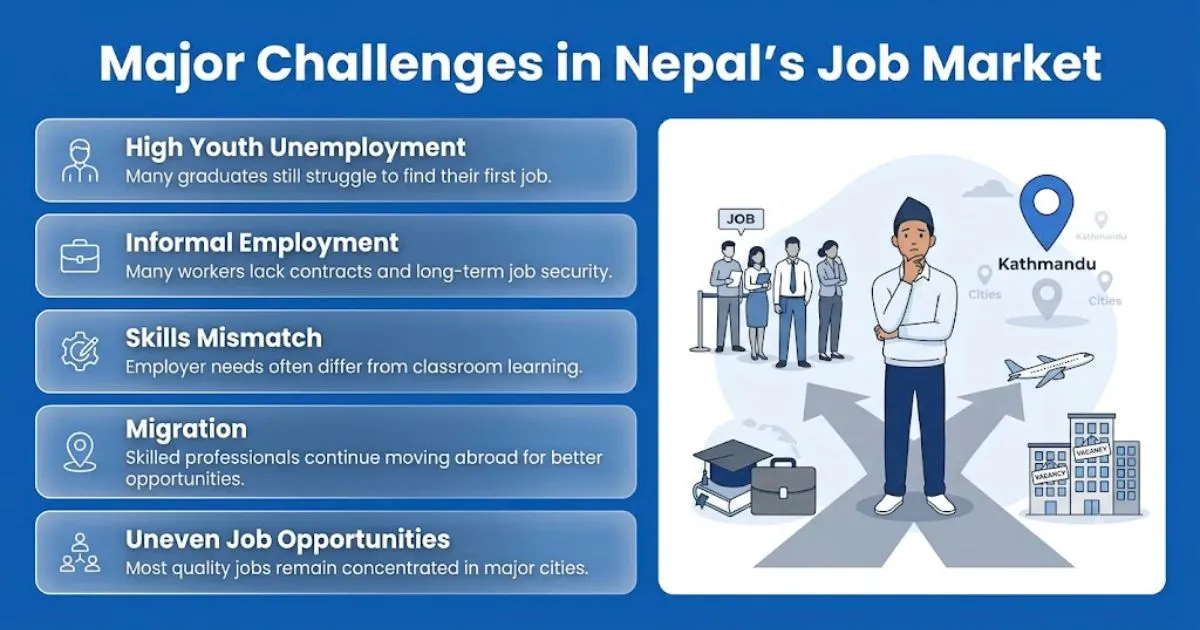
While Nepal's job market continues to create new opportunities in 2026, but it also has real problems that job seekers cannot ignore. Understanding these challenges helps set the right expectations, whether you are applying for your first job or planning a career switch. Here are the issues that continue to shape hiring, pay, and opportunity across the country.
1. High Youth Unemployment
Youth unemployment in Nepal remains high, reported above 20% based on the most recent completed surveys. This is one of the highest rates in South Asia. It means a large share of young people, even those with degrees, are still struggling to find their first proper job.
2. Informal Work
Most jobs in Nepal are still informal. An estimated 84 to 85% of workers do not have a formal contract, fixed salary, or social security benefits. Many people are technically "employed," but the work is unstable, low-paying, or seasonal, which is a bigger problem than the unemployment rate alone suggests.
3. Skills Mismatch
There is a real gap between what colleges teach and what employers actually need, especially in IT and technical fields. Many graduates come out with strong theoretical knowledge but limited hands-on, practical experience, which makes the first job harder to land.
4. Migration
Skilled workers, especially IT graduates, keep leaving Nepal within a few years of finishing their studies. Better pay, better infrastructure, and stronger career growth abroad remain the main reasons. This trend puts pressure on local companies trying to retain experienced talent.
5. Weak Hiring and Uneven Opportunities
Private-sector hiring hasn't fully recovered, even though big economic numbers like reserves and remittances look stable. On top of that, most good private-sector jobs are still concentrated in Kathmandu and a handful of other cities, leaving fewer formal opportunities for people in other parts of the country.
What Job Seekers Should Do
Understanding job market trends is important, but taking the right actions is what improves your chances of getting hired. Here are some practical steps to help you stand out in Nepal's job market in 2026.
- Build in-demand skills: Focus on skills that employers are actively hiring for, such as IT, digital marketing, engineering, and other technical fields.
- Work on real projects: A strong portfolio, personal projects, or internship experience often has more value than additional certificates alone.
- Improve your English communication: Good communication skills are essential for IT, BPO, remote work, and most private-sector jobs.
- Learn the right digital tools: Focus on the software and technologies required for your target role, and develop AI skills where they are genuinely useful.
- Create a strong portfolio: Showcase your best work, especially if you're applying for IT, design, marketing, or other skill-based roles.
- Research salary expectations: Understand current salary ranges so you can negotiate confidently during interviews.
- Consider freelancing as extra income: Freelancing can provide valuable experience and additional earnings, but it takes time to build a steady client base.
- Apply strategically: Customize your CV and applications for each role instead of sending the same application to every job opening.
Conclusion
Nepal's job market in 2026 is not simply good or bad. The economy is slowing down, private hiring is cautious, and youth unemployment stays high. But sectors like IT, hydropower, and freelancing show real growth, and that growth is creating genuine opportunities for people with the right skills.
The pattern is the same everywhere: employers want proof, not just a degree. A real project, an internship, or strong English communication can matter more than qualifications alone. Don't wait for the "perfect" market. Build something you can show, stay consistent, and the opportunities in 2026 are there for the taking.