

Artificial Intelligence (AI) is rapidly changing how people work around the world, and Nepal is no exception. From banking apps to customer support systems, AI is slowly becoming part of everyday business operations. As this shift continues, many people are asking whether AI will replace jobs in Nepal. While some roles may be affected, AI is also creating new opportunities. Understanding both the risks and benefits is important for job seekers, students, and professionals who want to stay prepared for the future.
Table of Contents
- What is Artificial Intelligence (AI)?
- Current Use of AI in Nepal
- AI in Banking and Finance
- AI in Customer Service (Chatbots)
- AI in Digital Marketing and IT Sector
- Will AI Replace Jobs in Nepal?
- Jobs in Nepal That Are at Risk Due to AI
- 1. Data Entry and Clerical Jobs
- 2. Customer Support Roles
- 3. Basic Accounting Jobs
- 4. Administrative and Office Work
- 5. Retail and Cashier Jobs
- 6. Graphic Design (Basic Level)
- 7. Content Writing (Basic Level)
- 8. Data Processing Jobs
- 9. Telemarketing Jobs
- 10. Translation Jobs (Basic Level)
- Jobs That Are Safe from AI in Nepal
- 1. Healthcare Professionals
- 2. Teachers and Educators
- 3. Skilled Trades (Electricians, Plumbers, Technicians)
- 4. Management and Leadership Roles
- Opportunities Created by AI in Nepal
- New Tech Jobs (AI, Data Science, IT)
- Freelancing and Remote Work Opportunities
- Growth in Digital Skills Demand
- Benefits of AI in Nepal
- 1. Increased Productivity
- 2. Business Growth and Innovation
- 3. Better Services and Efficiency
- 4. Cost Reduction for Businesses
- Challenges of AI in Nepal
- 1. Lack of Skilled Workforce
- 2. Limited Technology Infrastructure
- 3. Risk of Job Displacement
- 4. High Cost of AI Implementation
- How to Prepare for AI in Nepal
- Conclusion
What is Artificial Intelligence (AI)?
Artificial Intelligence (AI) refers to machines or software that can perform tasks that normally require human intelligence, such as learning from data, solving problems, and making decisions. It helps computers process information, recognize patterns, and respond in a smart way. As technology continues to develop, AI is becoming an important part of modern systems used by businesses and individuals. It is widely used to improve accuracy, save time, and handle large amounts of data efficiently.
AI is already part of everyday life, even if many people are not aware of it. Features like voice assistants, YouTube recommendations, Google search suggestions, mobile banking apps, and social media platforms all use AI to provide better and more personalized experiences. Around the world, AI is growing quickly as countries like the USA, China, and India invest in advanced technology and automation. Because of this rapid growth, businesses globally, including in Nepal, are adopting AI to increase efficiency, reduce costs, and remain competitive in the digital era.
Current Use of AI in Nepal
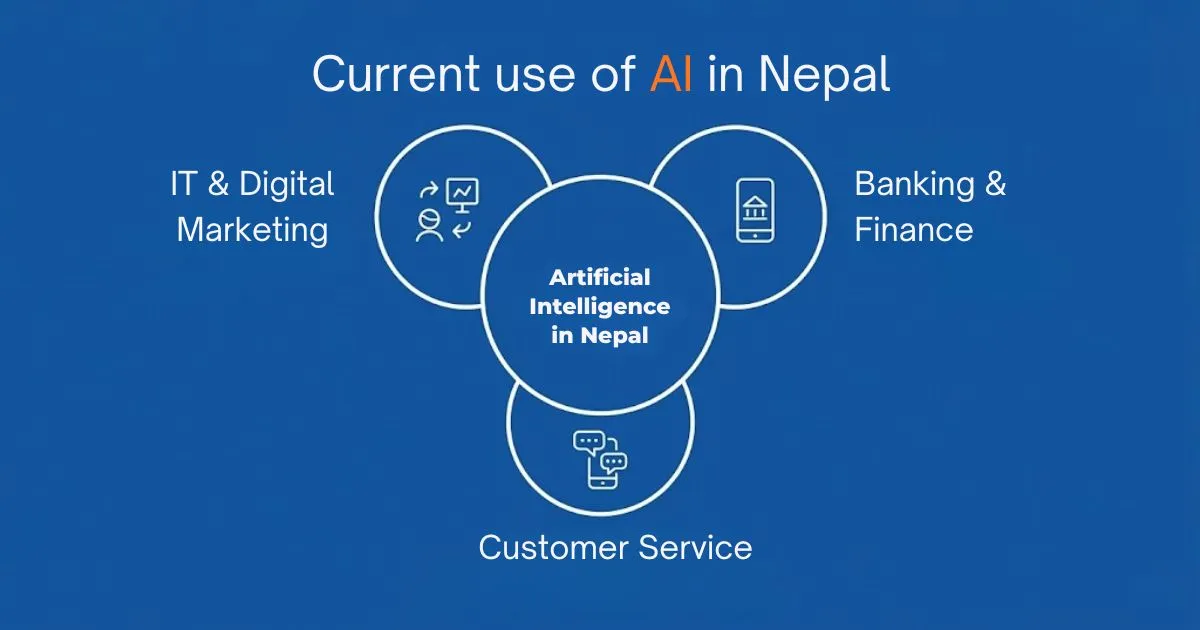
Artificial Intelligence is slowly becoming common in different industries in Nepal. Many businesses are now using AI to make their work easier, faster, and more accurate. It helps reduce manual effort, saves time, and improves service quality. Even though AI is still new in Nepal, its use is increasing in areas like banking, customer service, and digital marketing. As more companies adopt digital tools, AI will continue to grow and play a bigger role in everyday business activities.
AI in Banking and Finance
In Nepal, banks and financial organizations are using AI to make their services safer and more efficient. AI helps detect unusual activities in bank accounts, which helps prevent fraud and protect customers’ money. It also helps banks check financial risks before giving loans or making decisions. Some banks use AI systems to answer customer questions and provide quick support. Because of this, banking services become faster, more secure, and more reliable, which builds trust among customers.
AI in Customer Service (Chatbots)
Many companies in Nepal are now using AI chatbots to handle customer support. These chatbots are available on websites, mobile apps, and social media pages. They can reply to common questions instantly, such as product details, pricing, and basic help. This means customers do not have to wait for a human response. Businesses can provide support at any time, even at night or during holidays. At the same time, it reduces the workload for employees and helps companies save money while improving customer service.
AI in Digital Marketing and IT Sector
AI is widely used in Nepal’s digital marketing and IT industry. Businesses use AI tools to understand customer behavior and show the right ads to the right people. It also helps suggest content based on user interests, which improves engagement. In the IT sector, AI helps developers complete tasks faster by automating simple and repetitive work. It also improves software quality and reduces errors. As the IT sector in Nepal continues to grow, the use of AI is increasing and creating more opportunities in the tech field.
Will AI Replace Jobs in Nepal?
AI is changing how people work, but it will not replace all jobs in Nepal. It can do repetitive and simple tasks like data entry or basic office work. Because of this, some jobs may reduce, but most jobs will not disappear. Instead, the way people work will change. Workers will need to use AI tools in their daily tasks, which can make work faster and easier. Experts say that while some old jobs may decline, many new jobs will also be created, especially in technology and digital fields. In Nepal, this change will happen slowly, so people will have enough time to learn new skills and adjust to the future.
Here is How AI is affecting jobs in Nepal:
- Impact of Automation on Jobs: AI can do basic and repeated tasks like data entry, basic calculations, and routine office work, which may reduce some low-skill jobs but helps work become faster and easier.
- Jobs Will Change, Not Fully Disappear: Most jobs will not be removed completely, but the way people work will change, and workers will need to use AI tools in their daily tasks.
- Need for New Skills: People will need to learn digital skills, problem-solving, and creative thinking to stay updated and get better job opportunities.
- New Job Opportunities: AI will create new jobs in areas like IT, digital marketing, and technology, which can offer better career growth in Nepal.
- Slow Change in Nepal: The impact of AI in Nepal will not happen suddenly, so students and workers will have time to prepare and learn new skills for the future.
Jobs in Nepal That Are at Risk Due to AI
1. Data Entry and Clerical Jobs
Data entry and clerical jobs are highly at risk because they involve repetitive tasks like typing data, updating records, and managing files. AI software can do these tasks faster and with better accuracy. Many companies in Nepal are now using automated systems to handle large amounts of data, which reduces the need for human workers. As a result, job opportunities in this field may continue to decrease in the coming years.
2. Customer Support Roles
Basic customer support roles are slowly being replaced by AI chatbots. These chatbots can answer common questions instantly through websites, apps, and social media. They are available all the time and can handle many customers at once. While human support is still needed for complex problems, simple customer service jobs may reduce as more businesses adopt AI tools.
3. Basic Accounting Jobs
AI is making basic accounting work easier by handling tasks like bookkeeping, invoice generation, and expense tracking. Many small and medium businesses in Nepal now use accounting software instead of hiring staff for manual work. This reduces errors and saves time, but it also lowers demand for entry-level accounting jobs.
4. Administrative and Office Work
Administrative jobs that include tasks like managing emails, scheduling meetings, and organizing documents are also at risk. AI tools and office software can now handle these tasks quickly and efficiently. This reduces the need for manual office work and may affect administrative job roles in the future.
5. Retail and Cashier Jobs
Retail and cashier jobs are being affected by digital payment systems and online shopping trends. Many stores now use automated billing systems, and customers are shifting towards online purchases. Because of this, the need for cashiers and traditional retail workers may slowly decrease in Nepal.
6. Graphic Design (Basic Level)
Basic graphic design work, such as creating simple social media posts, banners, and logos, can now be done using AI design tools. These tools are easy to use and save time for businesses. As a result, companies may not hire beginner designers for small tasks. However, skilled designers who can create unique and creative designs are still in demand.
7. Content Writing (Basic Level)
AI tools can now generate basic content like blog drafts, product descriptions, and social media captions. This can affect entry-level content writing jobs in Nepal. However, AI cannot fully replace human creativity, storytelling, and deep understanding, so experienced writers still have strong opportunities.
8. Data Processing Jobs
Jobs that involve sorting, organizing, and analyzing data are also at risk. AI systems can quickly process large amounts of data with high accuracy. Many companies prefer using AI for these tasks because it saves time and reduces mistakes, which may reduce the need for manual data workers.
9. Telemarketing Jobs
Telemarketing jobs are being affected by AI-based calling systems and voice assistants. These tools can make calls, provide information, and respond to customers without human help. This reduces the need for telecallers, especially for basic sales and support calls.
10. Translation Jobs (Basic Level)
Basic translation work is also being impacted by AI translation tools. These tools can quickly translate text from one language to another, which is useful for simple tasks. While human translators are still needed for accurate and professional work, demand for basic translation jobs may decrease over time.
Jobs That Are Safe from AI in Nepal
1. Healthcare Professionals
Healthcare jobs like doctors, nurses, and medical staff are safe from AI because they require direct human care and attention. These roles involve treating patients, understanding their problems, and giving emotional support. AI can help doctors by checking reports or suggesting possible treatments, but it cannot replace the care and trust that humans provide. In Nepal, people value personal care in health services, so healthcare professionals will continue to be in high demand.
2. Teachers and Educators
Teaching is a job that depends on human interaction and understanding. Teachers not only teach lessons but also guide students, answer their questions, and help them grow. AI tools can support learning through online platforms, but they cannot replace a teacher’s role in motivating and supporting students. In Nepal, teachers play an important role in education, so this job will remain stable in the future.
3. Skilled Trades (Electricians, Plumbers, Technicians)
Jobs like electricians, plumbers, mechanics, and technicians require physical work and practical skills. These jobs involve solving real problems in different situations, which AI cannot easily handle. People in Nepal will always need these services, so skilled trade jobs will remain secure and in demand.
4. Management and Leadership Roles
Management jobs involve leading teams, making decisions, and handling business activities. These roles require human thinking, experience, and communication. AI can help by providing data and suggestions, but it cannot replace human leadership. In Nepal, companies will always need managers and leaders to guide their teams and make important decisions.
Opportunities Created by AI in Nepal
AI is not only changing jobs but also creating many new opportunities in Nepal. As more businesses start using AI tools, new types of jobs and skills are becoming important. People who learn and adapt to these changes can find better career options and income opportunities. AI is opening doors in technology, online work, and digital skills, which is helping many Nepali professionals grow in their careers.
New Tech Jobs (AI, Data Science, IT)
AI is creating many new job opportunities in the technology sector. Jobs like software developers, data analysts, AI engineers, and IT professionals are now in high demand. These roles involve working with data, building systems, and using technology to solve problems. In Nepal, the IT sector is growing fast, and companies are looking for skilled people who understand AI and digital tools. These jobs also offer good salary and long-term career growth for those who have the right skills.
Freelancing and Remote Work Opportunities
AI tools are making it easier for people in Nepal to work online and earn from international clients. Freelancers can use AI to complete tasks faster, improve quality, and manage multiple projects. Platforms like freelancing websites allow Nepali professionals to work with clients from different countries. This increases income opportunities and gives people the chance to work from home. Remote work is becoming more popular, especially in fields like writing, design, and IT.
Growth in Digital Skills Demand
As AI use increases, there is a high demand for digital skills in Nepal. Skills like coding, data analysis, digital marketing, and using AI tools are becoming very important. Students and job seekers who learn these skills can find better job opportunities in the future. Many businesses now prefer employees who have digital knowledge and can work with modern tools. This shift is creating new career paths and helping people move towards better and more secure jobs.
Benefits of AI in Nepal
1. Increased Productivity
AI helps businesses complete tasks quickly and with fewer mistakes. Work that used to take more time can now be done faster with the help of AI tools. This improves overall productivity and allows employees to focus on more important and skilled work. As a result, companies can perform better and grow faster.
2. Business Growth and Innovation
AI supports business growth by helping companies create new products and services. Businesses in Nepal can use AI to understand customer needs and market trends. This helps them improve their ideas and stay competitive. Startups can also use AI to grow faster and reach both local and international markets.
3. Better Services and Efficiency
AI improves service quality by making processes faster and more accurate. Customers can get quick responses and better support without long waiting times. AI also reduces errors in work, which increases trust and satisfaction. In Nepal, this is helping businesses provide more reliable and efficient services.
4. Cost Reduction for Businesses
AI helps businesses reduce costs by automating many routine tasks. Companies do not need to spend as much on manual work, which saves money in the long run. It also reduces errors that can lead to financial loss. In Nepal, this helps small and medium businesses manage their budget better and increase profit.
Challenges of AI in Nepal
1. Lack of Skilled Workforce
One of the main challenges of AI in Nepal is the lack of skilled people who understand AI and modern technology. Many workers do not have knowledge of programming, data, or AI tools. Because of this, companies find it difficult to use AI properly. This slows down the growth of AI in different industries.
2. Limited Technology Infrastructure
Nepal still faces problems like slow internet, limited access to advanced technology, and lack of proper digital systems. These issues make it hard for businesses to fully use AI tools. Without strong infrastructure, the growth of AI in Nepal can be limited.
3. Risk of Job Displacement
AI can replace some simple and repetitive jobs, which may lead to job loss for certain workers. People who do not have updated skills may find it difficult to get new jobs. This can create economic and social challenges if proper training and support are not provided.
4. High Cost of AI Implementation
Using AI technology can be expensive for many businesses in Nepal. Small and medium companies may not have enough budget to invest in AI tools, software, and training. Because of high costs, many businesses are slow to adopt AI, which delays overall progress.
How to Prepare for AI in Nepal
To prepare for AI in Nepal, people need to learn new skills and be ready for changes in jobs. As technology is growing, it is important to understand basic digital tools and how they work. Learning skills like coding, data work, and basic AI knowledge can help people get better job opportunities. At the same time, human skills like communication, creativity, and problem-solving are also very important because AI cannot fully replace them. People should keep learning new things and stay updated so they can adjust easily in the future job market.
- Learn Digital and Tech Skills: Try to learn basic coding, data handling, and how to use modern digital tools. These skills are becoming important in many jobs in Nepal, especially in IT, banking, and digital marketing, and can help you find better career opportunities.
- Improve Human Skills: Focus on skills like communication, creativity, teamwork, and problem-solving. These are skills that AI cannot easily replace and are needed in almost every job, helping you stay valuable in the workplace.
- Keep Learning New Skills: Do not stop learning after one course or degree. Join online classes, training programs, or workshops to keep improving your knowledge and stay updated with new job requirements.
- Follow New Technology Trends: Stay informed about new tools, apps, and AI updates. This helps you understand what skills are in demand and prepares you for future job changes in Nepal.
Conclusion
AI will not completely replace jobs in Nepal, but it will change how people work in many industries. Some jobs may reduce, especially those with basic and repetitive tasks, but at the same time, many new job opportunities will be created. The most important thing is to be ready for change by learning new skills and improving knowledge. People who stay flexible, keep learning, and understand new technology will have better career chances. By preparing from now, individuals in Nepal can build a secure and successful future in a world where AI is becoming more common.