


If you are a student in Nepal thinking about a career in software development, you have probably asked yourself questions like: Where do I start? Do I need a computer science degree? Which programming language should I learn first?
In this guide, you will learn how to become a software developer in Nepal, with a clear, step by step roadmap you can actually follow.
What Does a Software Developer Actually Do?
A software developer writes, tests, and maintains the code that powers websites, mobile apps, and computer programs. In simple words, if you use an app to order food, check your bank balance, or chat with friends, a software developer helped build the code behind it.
Software development is not just writing code. It also includes understanding a problem, planning a solution, testing your work, fixing bugs, and working with a team to improve the product over time.
Is Software Development a Good Career in Nepal?
Yes, software development is one of the growing career paths in Nepal right now. More IT companies, software houses, and startups are hiring developers in cities like Kathmandu, Lalitpur, and Pokhara. Many Nepali developers also work remotely for international companies or take up freelance work.
That said, it is important to be realistic. The field is competitive, especially for entry level roles, because more students are entering IT every year. Getting your first job usually depends less on your college name and more on your actual skills, projects, and how well you can prove them. You can also checkout on our detailed guide on how much does an software developer earn in Nepal.
Step by Step Roadmap to Become a Software Developer in Nepal
Here is the general order most beginners should follow. You do not need to rush. Focus on understanding, not just finishing.
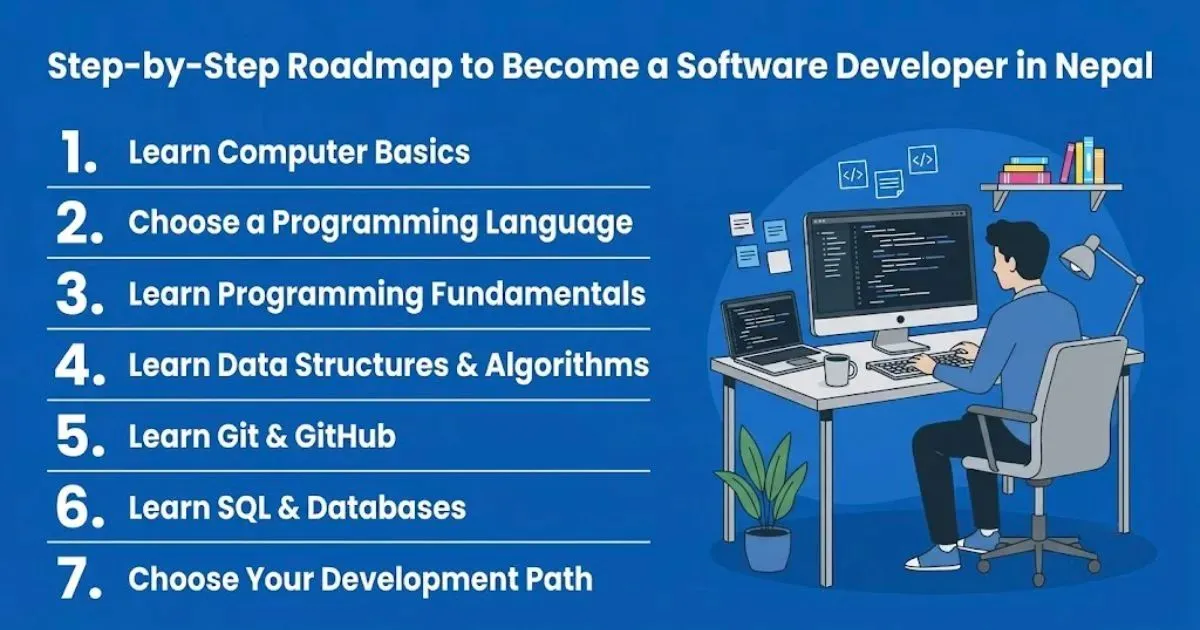
1. Understand Basic Computer
Before learning any programming language, get comfortable with how computers work in general. This includes files and folders, the difference between hardware and software, and basic terms like input, output, and program. If you already use a computer daily, you likely know most of this already.
2. Choose One Programming Language to Start
Beginners often get confused because there are many programming languages. You do not need to learn all of them. Pick one and go deep first. Common beginner friendly choices include:
- Python: Known for simple, readable syntax. Good for absolute beginners.
- JavaScript: Useful if you want to build websites, since it works in every browser.
- Java: Commonly taught in Nepali colleges and used in many enterprise systems.
There is no single best language. Choose one based on what interests you, and stick with it until you are comfortable.
3. Learn Programming Fundamentals
Once you pick a language, focus on the core concepts that apply to almost every language:
- Variables and data types
- Conditional statements (if/else)
- Loops
- Functions
- Basic input and output
- Simple error handling
Practice by writing small programs, such as a calculator, a number guessing game, or a simple to do list in the terminal. Do not just watch tutorials. Type the code yourself, break it, then fix it.
4. Learn Data Structures and Algorithms
Data structures and algorithms (DSA) sound intimidating, but at the beginner stage, you only need the basics. This includes arrays, lists, dictionaries or maps, basic sorting, searching, and simple problem solving practice. You do not need to master advanced DSA right away. A solid beginner level understanding is enough to start building projects and applying for entry level jobs. You can strengthen this skill gradually over time.
5. Learn Git and GitHub
Git is a tool that tracks changes in your code, and GitHub is a website where developers store and share their code. Almost every software job in Nepal expects at least basic Git knowledge. Learn how to:
- Create a repository
- Commit and push changes
- Create and use branches
- Open a pull request
This is also where you will host your projects to show employers.
6. Learn Databases and Basic SQL
Most real applications need to store data, such as user accounts, products, and messages. Learn the basics of relational databases and SQL, including how to create tables and how to insert, update, delete, and query data using SELECT statements. You do not need to become a database expert immediately, but understanding how data is stored and retrieved is essential for almost every development path.
7. Choose a Development Path
Once your fundamentals are solid, it is time to specialize. Trying to learn everything at once is one of the biggest reasons beginners feel overwhelmed and give up. Pick one path, get good at it, and expand later if you want.
- Frontend Development: Frontend developers build what users see and interact with in a browser, such as layouts, buttons, forms, and design. Common technologies include HTML, CSS, JavaScript, and frameworks like React. This is a good fit if you enjoy design, user experience, and visual work.
- Backend Development: Backend developers build the logic, database connections, and APIs that run behind the scenes. Common technologies include Node.js, Python, Java, PHP, or C#, along with databases like MySQL or PostgreSQL. This is a good fit if you enjoy logic, problem solving, and working with data.
- Full Stack Development: Full stack developers work on both frontend and backend. This path takes longer to become comfortable with, but it is common among Nepali developers, especially at smaller companies and startups where one developer handles more responsibilities.
- Mobile App Development: Mobile developers build apps for Android or iOS, often using tools like Kotlin, Java, Swift, or cross platform frameworks like Flutter or React Native. This is a good fit if you specifically want to build mobile apps rather than websites.
How to choose: Think about what kind of applications excite you. If you like building things people can see and click on quickly, frontend is a good start. If you enjoy logic and understanding how things work behind the scenes, try backend. There is no wrong choice, since you can always add more skills later.
Do You Need a Computer Science Degree?
This is one of the most common questions among Nepali students, so let's be direct about it.
A degree in the IT Field like BSc CSIT, BCA, BIT, BSc IT, or BE Computer is helpful. It gives you structured learning, exposure to programming, math, and computer fundamentals, and it can make it slightly easier to get interviews at some companies, especially larger ones.
However, a computer related degree is not strictly required to become a software developer. Many self taught developers in Nepal and around the world have built successful careers through consistent self learning, projects, and practical experience. What matters most to employers is usually simple:
- Can you actually build things?
- Do you understand the fundamentals?
- Can you solve problems and learn quickly?
If you are a +2 student, a bachelor's student in a non IT field, or someone changing careers, you can absolutely start learning software development on your own. It will take discipline and consistency, but it is a realistic path. Your degree, if you have one, mainly adds credibility. Your skills and projects are what actually get you hired.
Importance of Building Projects and a Portfolio
In Nepal's job market, many applicants have similar academic backgrounds. What sets candidates apart is often their projects. A project shows employers that you can actually apply what you learned, not just memorize theory for exams.
Beginner to Intermediate Project Ideas
- To do application (with add, edit, and delete features)
- Weather application (using a public weather API)
- Simple blog application (create, read, update, delete posts)
- Basic e commerce website (product listing, cart, checkout flow)
- Authentication system (sign up, login, password reset)
- Expense tracker (record and categorize spending)
- Any project that uses a public API (news, movies, currency conversion, etc.)
What Makes a Project Valuable
A good project is not about how big it looks. Employers care more about:
- Whether you understand how your own code works and can explain it in an interview
- Clean, readable code
- Proper use of Git, with regular commits and clear messages
- A short README explaining what the project does and how to run it
- Real functionality, not just a copied design with no working logic
Avoid simply copying a tutorial project without understanding it. Employers can usually tell during interviews when a candidate cannot explain their own code.
Presenting Projects on GitHub and Your CV
- Keep your GitHub profile organized, with a few solid projects rather than many incomplete ones
- Add clear README files with screenshots if possible
- On your CV, list two to four of your best projects with a one line description of what each one does and which technologies you used
- Link your GitHub, and a live demo link if you have one
Preparing Your CV for Fresher Job Roles
Keep your CV simple, honest, and focused. Include your skills, projects with links, education, any internships, and relevant certifications if you have them. Avoid listing every technology you have briefly touched. List what you can genuinely talk about in an interview. For more information about CV writing, check out our detailed guide with CV samples and tips on how to write a CV.
How to Get a Software Development Job in Nepal
Knowing the required skills is not enough. What actually helps is knowing where to look and how to use these platforms the right way.
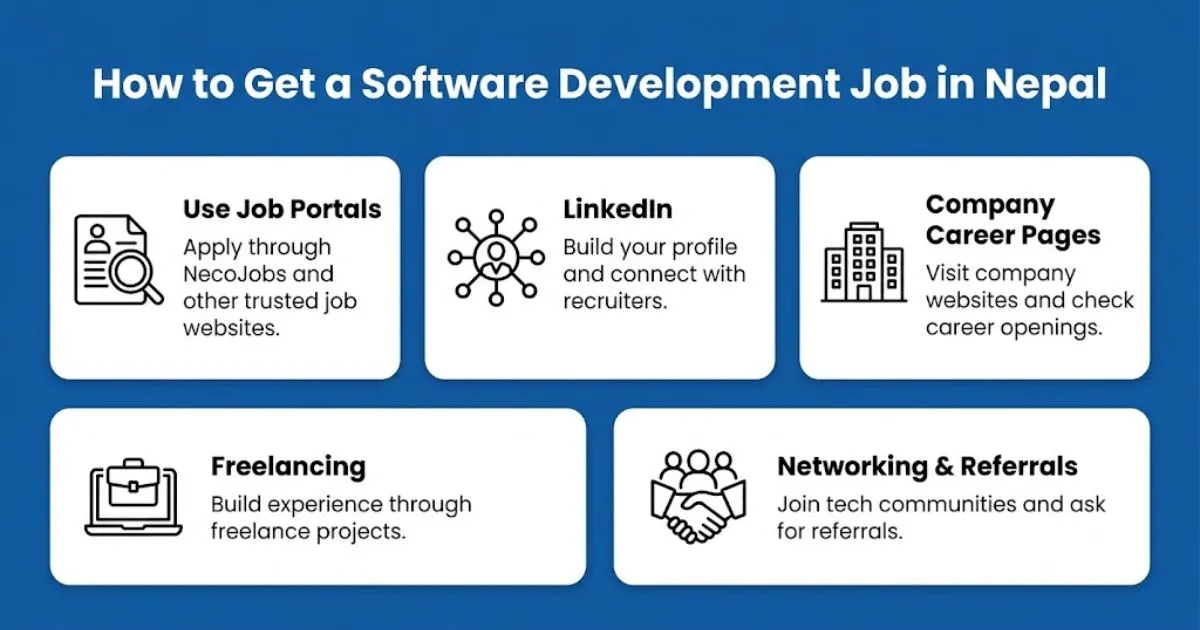
1. Use Job Portals
Job Portals like NecoJobs regularly post internship and entry level developer openings from Nepali IT companies. Create a profile, upload an updated CV, and filter listings by "IT," "software," or "developer" rather than checking the entire site randomly. Check it two or three times a week, since good listings fill up fast.
2. Use LinkedIn the Right Way
Most Nepali IT companies and recruiters are active on LinkedIn. Build a simple profile that includes your GitHub link, projects, and skills. Follow Nepali tech companies you like, turn on job alerts for terms like "junior developer Nepal" or "software developer intern," and send a short, polite message to a recruiter when you find a role you are interested in.
3. Check Company Career Pages
Bigger Nepali IT companies usually list current openings on their own websites under a "careers" or "jobs" page. If there are a few companies you would love to work at, visit their career pages every few weeks, even if they show no current openings, since new roles get added often.
4. Try Freelancing
Platforms like Upwork and Fiverr let you take on small paid projects while you are still job hunting. This is especially useful if local job openings are limited at the moment, since it gives you real client experience, income, and something concrete to show in interviews.
5. Network and Ask for Referrals
Attend local meetups, hackathons, and tech events in your city, and join Nepali developer groups on Facebook or Discord, since openings are often shared there first. If a senior, teacher, or college alumnus already works at an IT company, a short and polite message asking about openings can also go a long way. Many entry level roles in Nepal get filled through referrals before they are even posted publicly.
Common Mistakes to Avoid
Many beginners in Nepal follow the right roadmap but slow themselves down with a few avoidable habits. Here are the most common ones and how to fix them.
- Learning too many technologies at once: Focus on one language and one path first. You can expand later once you are confident.
- Watching tutorials without building anything: Tutorials help you understand concepts, but skills come from building your own projects, even small ones.
- Copying projects without understanding them: If you cannot explain your own code, it will not help you in interviews. Build slowly and understand each part.
- Ignoring Git and GitHub: This is a basic expectation in almost every developer job. Learn it early, not at the last minute.
- Having no portfolio: Even two or three solid, well explained projects are far more useful than none.
- Giving up because progress feels slow: Programming has a learning curve for everyone. Consistency over months matters more than speed.
Conclusion
Becoming a software developer in Nepal is a realistic goal if you follow the right process. Start with the fundamentals, choose one development path instead of trying to learn everything, build real projects, and apply consistently once you are ready. Your degree can help, but it is your skills, your projects, and your ability to keep learning that will actually get you hired and help you grow in this career. There is no shortcut that skips the learning itself, but with steady, focused effort, this is achievable for any student in Nepal.