

Are you a student or a fresh graduate in Nepal wondering what you should build to actually get hired? You have probably heard the advice a hundred times: "build projects." But nobody tells you which projects matter and why recruiters care about them at all.
Here is the reality. Recruiters in Kathmandu and across Nepal go through hundreds of CVs every month. Most of them look the same. A to do list app. A basic calculator. A "student management system" copied straight from a YouTube tutorial. None of these stand out anymore.
What actually catches a recruiter's eye is a project that proves you can think like a real developer. Someone who can solve a real problem, pick the right tools, and explain their work confidently in an interview. This guide will help you choose the right projects, not just the most projects, so you can get a job faster.
How to Build a Job-Ready IT Project
Before choosing a project, it's important to understand what recruiters actually look for. A strong project solves a real problem, not a classroom exercise, and it shows you made your own decisions instead of copying a tutorial. It uses relevant tech, looks clean, stores data in a real database, connects to an API, handles login properly, and is deployed online so anyone can open it.
Recruiters also look at how you work. A steady GitHub commit history, organized code, and a clear README all say more about you than the project itself. But nothing matters more than being able to explain your choices when someone asks. And you don't need many projects. Two or three you can explain about in depth will always beat ten basic ones copied from the same tutorial.
Best IT Projects to Include in Your Portfolio
Here are project ideas grouped by career path. Pick the ones that match the job you're targeting, you don't need to build from every category.
1. Web Development Projects
Best for Software Developer, Full Stack Developer, or Web Developer roles.
E commerce Website: An online store with cart and checkout. Shows database design, authentication, and payment logic. Build with React/Vue, Node.js/Django, and MongoDB/PostgreSQL. Add search, an admin dashboard, and order tracking. Strong for Full Stack, Frontend, or Backend roles.
Inventory Management System: Tracks stock, purchases, and sales. Shows database relationships and CRUD skills. Build with Django, Laravel, or Spring Boot. Add low stock alerts and sales reports. Good for Backend and Full Stack roles.
Blog or CMS: Lets users write and publish posts. Shows authentication and role management between authors and admins. Use React/Next.js with Node.js or Django. Add comments, tags, and SEO friendly URLs. Best for Full Stack and Frontend roles.
Hospital Management System: Manages patients, appointments, and schedules. Shows complex database design and form validation. Build with Laravel, Spring Boot, or Django. Add booking and prescription history. Good for Backend and Full Stack roles.
Restaurant Management System: Handles reservations, orders, and billing. Shows CRUD and real time logic. Use React with Node.js/Express. Add a kitchen order display and digital receipts. Suited for Full Stack and Frontend roles.
Online Booking System: Books appointments, tickets, or services, think salon bookings or bus tickets, familiar territory for a Nepali audience. Shows date handling and availability logic. Use React/Vue with Node.js/Django. Add a calendar view and payment integration. Good for Full Stack and Backend roles.
Expense Tracker: Tracks income and expenses. A great beginner friendly full stack project with CRUD, charts, and authentication. Use React with Chart.js and Node.js/Express. Add monthly reports and budget alerts. Works for Frontend and Full Stack roles.
Learning Management System (LMS): Lets instructors upload courses and students track progress. Shows role based access and file uploads. Use React/Next.js with Django or Node.js. Add quizzes and certificates. Strong for Full Stack roles.
2. Frontend Development Projects
For Frontend Developer roles, your project should show responsive design, API integration, state management (Redux, Zustand, or React Context), form handling, authentication, and clean, component based UI.
A weather app using a public API is a great starting point for learning API calls. A movie or recipe search app takes it up a notch with search and filters. A portfolio website with animation shows design sense. A dashboard UI with charts and tables proves you can build complex layouts.
The e-commerce or blog/CMS frontend, connected to a real or mock API, works especially well since it combines multiple frontend skills in one project.
3. Backend Development Projects
For Backend Developer roles, focus on REST API design, authentication (JWT, sessions, role based access), database design, CRUD operations, API security, and error handling.
A REST API for a blog or e-commerce system with role based permissions is a solid start. A URL shortener sounds small but shows real database design skill. A task management API with teams and permissions goes further. A notification or email service other apps can call shows backend architecture thinking.
The hospital management and inventory management backends, built as standalone APIs, work well here too.
4. Full Stack Projects
A full stack project combines frontend, backend, and database work into one app. This matters because most junior developer postings in Nepal want someone who can work across the stack, especially at smaller companies and startups.
An e-commerce website, booking system, or LMS, built end to end with your own backend, not just a frontend connected to someone else's API. It proves you can design a database, secure an API, build a working frontend, and deploy the whole system, which is far more convincing than two separate frontend only and backend only projects.
5. Python, Data, and AI Projects
For Python Developer, Data Analyst, Data Science, AI/ML, or Automation roles, keep it practical and easy to explain. Skip deep learning projects you can't defend in an interview, a copied notebook won't survive the question "why did you choose this approach."
Python/Automation: a web scraper for job listings or prices, an automation script for repetitive tasks, or a budget CLI tool.
Data Analyst: a data cleaning project using Pandas on a public dataset like Nepal census or e commerce sales data, or a dashboard built with Power BI, Tableau, or Streamlit.
Data Science/AI/ML: a prediction model on a well understood dataset like house prices, or a classification project like a spam detector using scikit-learn. Keep it simple enough to explain the full process: data collection, cleaning, model choice, and results.
6. QA and Testing Projects
Not every job seeker is a developer, and QA roles don't need a full application. Write test cases and test plans for an existing app. Find real bugs on a public website and write proper bug reports. Test a public API with Postman and document it. For more advanced work, automate a login flow with Selenium or Cypress.
A QA portfolio that shows structured thinking, attention to detail, and comfort with tools like Postman and bug tracking is very convincing to recruiters, even without a single line of app code.
7. UI/UX Projects
For UI/UX Designer roles, recruiters want your design process, not just pretty screens. A strong case study includes user research, wireframes, user flows, a clickable Figma prototype, responsive design, and a design system. If you redesigned an existing app, explain what was broken and how you fixed it.
Try redesigning a local Nepali business's website or app, or designing a mobile app for a real local problem like transport or food delivery. A case study without the "why" behind your decisions is far weaker than one that walks through your process.
8. Cybersecurity, Networking, and IT Support Projects
For Cybersecurity, Networking, IT Support, or System Administration roles, keep it realistic, safe, and legal, never attack systems you don't have permission to test.
A home lab network setup with a router, switch, and VLANs, documented with diagrams, is a great starting point. A VM security lab using VirtualBox or VMware lets you practice OS hardening and firewall configuration on your own systems. A vulnerability assessment report using Nmap or OpenVAS on your own lab works well too. Helpdesk documentation showing how you handled sample support tickets is great for IT Support roles. For something more advanced, try a basic security monitoring lab using a free tool like Wazuh.
These mirror real day to day tasks in entry level cybersecurity and support jobs, recruiters want to see you can set things up, document clearly, and stay safe while doing it.
Project Difficulty Levels
Choose projects based on your current skill level and your target job, not by trying to complete every single idea on this list.
Best Projects by IT Job Role
How to Make a Project Stand Out
Building a project is only half the work. Here's how to turn a basic student project into something that actually impresses recruiters in Nepal.
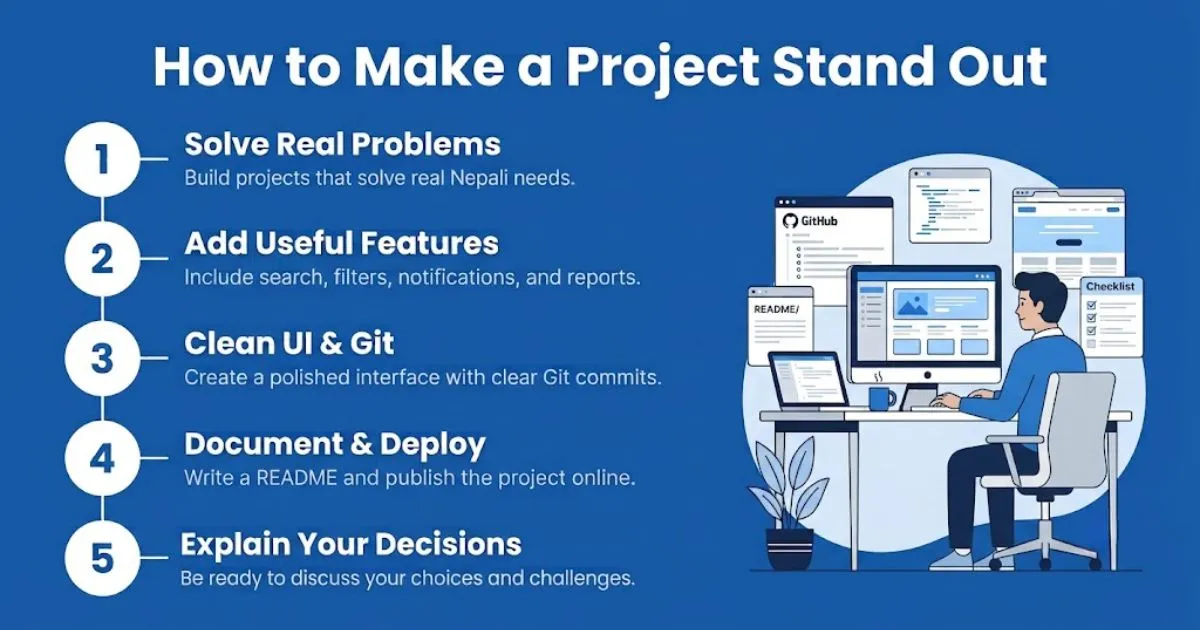
1. Solve a Problem People in Nepal Actually Face
Skip the generic tutorial clone. Base your project on something real, like local delivery, managing a small local business, or a process students deal with at college. A project tied to a real, familiar problem is instantly more interesting than a random idea from YouTube.
2. Add Features That Go Beyond the Basics
Don't stop at the minimum version. Add search, filters, notifications, or simple reports. These small additions show you think about what a real user would actually need, not just what's easiest to build.
3. Clean Up the UI and Keep Your Git History Honest
Spend real time making it look clean and usable, not just functional. And commit your code regularly with clear messages, like "add user authentication" instead of just "update." A messy one-commit upload tells recruiters you didn't build it step by step.
4. Document It and Put It Online
Write a proper README explaining what the project does, how to install it, and what technologies you used, and add a few screenshots so recruiters can understand it without even running it. Then deploy it using a free option like Vercel, Netlify, Render, or Railway. A working live link is far more convincing than code sitting untouched on GitHub.
5. Be Ready to Talk About It
Know why you picked a certain database, framework, or approach. Be honest about the challenges you ran into and how you solved them. If you actually improved something, like page load time, mention it, but only if it's true. This is often what separates candidates in the interview room.
How to Present Projects on GitHub
When a recruiter opens your GitHub repository, they should be able to quickly find a few key things. A meaningful repository name, not something like "project1" or "test repo." A README file, since this is usually the first thing recruiters read. A clear project description explaining what the app does and who it's for. The technologies used, listed clearly and often with badges or icons.
A features list showing what the app can actually do. Installation and setup instructions so someone can run the project locally. At least two or three screenshots showing the app in use. A live demo link if the project is deployed. A clean code structure with organized folders, such as separate frontend, backend, and components directories. And finally, a commit history that shows steady, real progress rather than one giant "final upload" commit.
A messy, undocumented repository makes recruiters assume the project isn't fully understood by the candidate, even if the code itself is actually decent.
Projects vs Certificates
Certificates show that you completed a course. Projects show that you can actually apply what you learned. Recruiters in Nepal see many candidates with similar certificates, especially from free online courses, so certificates alone don't really set you apart from other applicants.
A working project, on the other hand, proves hands on ability. You had to make decisions, debug errors, and complete something from start to finish. This doesn't mean certificates are useless. They're helpful as supporting evidence. But candidates shouldn't depend only on certificates when applying for IT jobs, since projects carry far more weight in demonstrating real, practical skill.
Common Project Mistakes to Avoid
Most students don't lose out because they lack skill. They lose out because of small, avoidable mistakes in how they build and present their projects. Here are the ones that show up most often.
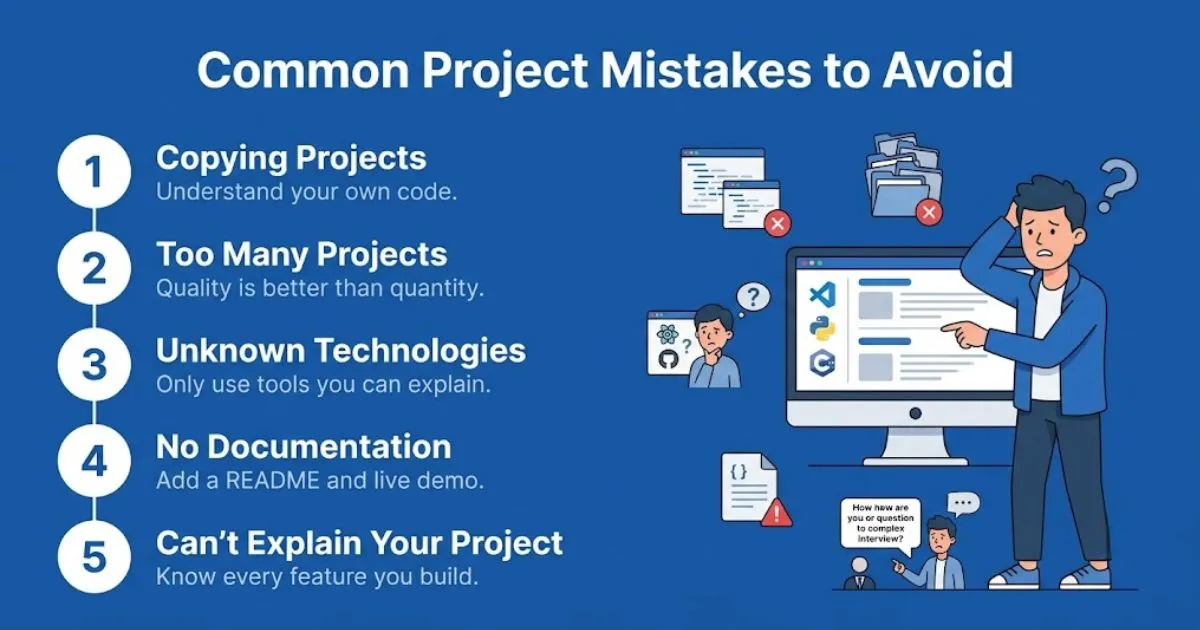
1. Copying Projects Without Understanding Them
Building only basic CRUD projects with no real features, or copying a project straight from YouTube, is a common trap. If you can't explain a line of your own code, don't include it in your portfolio. Recruiters can tell the difference fast.
2. Listing Too Many Projects on Your CV
More is not better here. Two or three strong, well built projects beat ten weak ones every time. A long list of shallow projects actually makes recruiters trust your CV less, not more.
For professional CV writing tips, you can also check out our complete guide on how to write a CV with samples.
3. Using Tech You Can't Explain
Adding a fancy framework or tool just to sound impressive backfires the moment someone asks you a follow up question about it. Only list what you genuinely understand.
4. Skipping Documentation and a Live Demo
No GitHub documentation makes your repository look unfinished, and no live demo hurts you badly, especially for frontend or full stack roles. A poor UI doesn't help either, even if your backend logic is solid underneath.
5. Not Being Able to Explain Your Own Project
This is the biggest one. A project with no real problem being solved, or AI generated code you copy pasted without understanding, will fall apart the second a recruiter asks you to walk through it. Being unable to explain your own work is one of the fastest ways to lose credibility in an interview.
How to Choose the Right Project
With so many project ideas floating around online, it's easy to feel stuck or end up building something that doesn't actually help you. The trick is to work backward from the job you want, not forward from whatever tutorial you found first. Here's a simple way to narrow it down.
- Decide your target job: Pick a specific role, like Frontend Developer, QA Engineer, or Data Analyst, instead of trying to prepare for everything at once.
- Check what skills that job actually needs: Look at three to five real job postings in Nepal for that role and note the skills that keep repeating.
- Pick a project and technology that match: Choose an idea from this guide that lines up with those skills, and use tools that are actually asked for in postings rather than whatever is trending online.
- Plan focused features: Keep the scope realistic so the project stays sharp instead of turning into something half finished.
- Build and deploy it: Commit your progress on Git regularly instead of uploading everything in one go, then put it online with a live link.
- Document it and add it to your CV: Write a clear README with screenshots, then add the project to your CV using the format shown earlier in this guide.
- Prepare to talk about it: Be ready to explain your decisions, the challenges you faced, and what you'd improve if you built it again.
Conclusion
Getting an IT job in Nepal doesn't come down to how many projects you can list on your CV. It comes down to whether you can point to two or three projects and talk about them like you actually built them, because you did. Pick a project that matches the job you want, build it properly, deploy it, document it well, and be ready to explain every decision you made along the way. That's what turns a student project into something a recruiter actually remembers.
To get hired faster, you need the right skills along with strong projects. Consider joining a NecoJobs Professional Training course to build practical skills and become job-ready.