


Finding a good job in Nepal is not always easy, but banking jobs remain one of the most popular and trusted career options. Banks are respected, provide stable income, and offer many chances to grow. In this guide, we will look at the types of banks, current vacancies, how to apply, required skills, and what you can expect in terms of salary and career growth.
Table of Contents
- Banking Career in Nepal
- Types of Banks and Financial Institutions in Nepal
- 1. Big Banks (Commercial Banks)
- 2. Growth Banks (Development Banks)
- 3. Finance Companies
- 4. Microfinance Institutions
- 5. Other Institutions
- Banking Job Vacancies in Nepal
- 1. How to Find the Latest Bank Jobs
- 2. Popular Jobs in Banks
- 3. Banks That Are Hiring
- 4. Bank Internships: A Great Start for Students
- 5. Where to Look for Banking Jobs
- Don’t Limit Your Search to Kathmandu
- The Complete Guide to Applying for Banking Jobs in Nepal
- Preparation
- Applying and Preparing for Exams
- Doing Well in the Interview
- Essential Skills and Qualifications for a Banking Jobs
- 1. Academic Requirements and Certificates
- 2. Technical Skills You Need
- 3. Soft Skills That Help You Succeed
- 4. Keep Learning and Improving
- Career Progression and future growth in Banking Sector
- Conclusion: Why Choose a Banking Career in Nepal?
Banking Career in Nepal
The banking sector in Nepal plays a very important role in the country’s economy. Banks are known for being safe, respected, and full of opportunities. In recent years, they have also been moving towards digital banking, which has created even more demand for new employees. By the end of 2026, banks are hiring actively to keep up with growth and new technology. A banking job is not just about earning a salary—it also gives you security, respect in society, and a chance to build a long-term career. Whether you are just graduating or already working in another field, the banking sector in Nepal can be a great choice for your future.
Types of Banks and Financial Institutions in Nepal
Nepal has many types of banks and financial organizations. Each one has its own job and role in helping people and the country’s economy. These banks and institutions provide money services to people, businesses, and communities. They also give many job opportunities for people who want to work in banking. If you want a banking career, it is important to know the different types of institutions, what they do, and how working in them can help you grow in your career.
1. Big Banks (Commercial Banks)
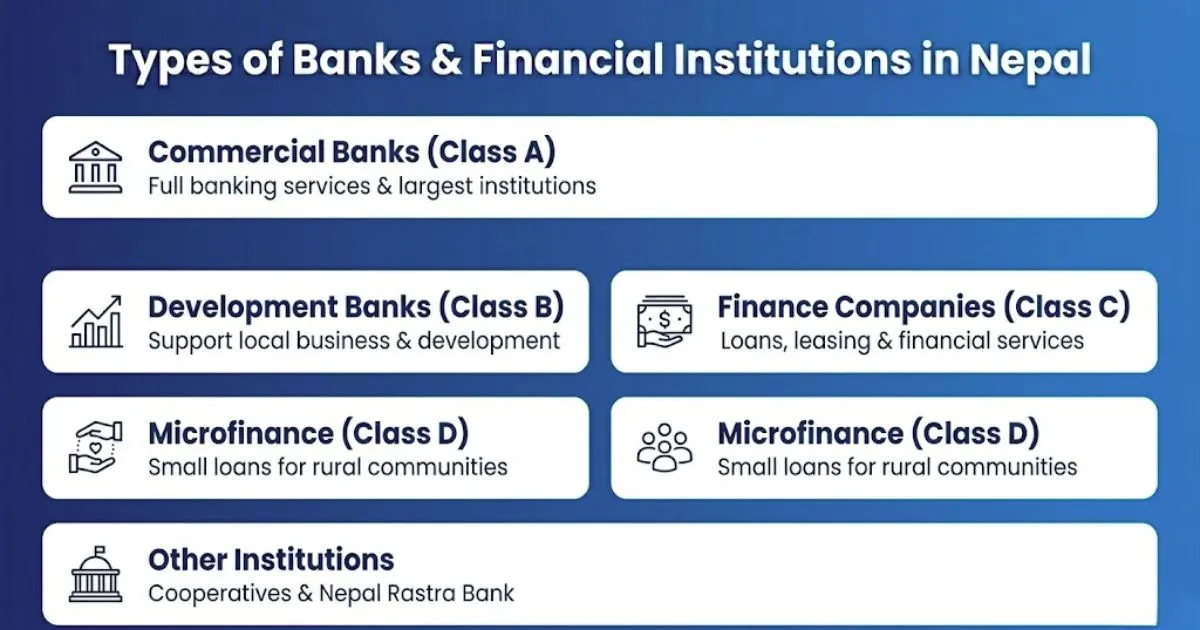
Big banks, also called Class “A” commercial banks, are the largest banks in Nepal. They are very important because they handle the most money and give many services. They help people open savings accounts, get loans for business or personal needs, and support companies that trade with other countries. Some popular commercial banks are Nabil Bank, Rastriya Banijya Bank (RBB), NIC Asia Bank, and Global IME Bank. Many people want to work in these banks because they are safe, respected, and have branches in almost every city and town. Working in a big bank gives training, experience, and chances to grow in your career. If you want a strong and long-term job in banking, starting in a big bank is a good idea.
2. Growth Banks (Development Banks)
Growth banks, also called Class “B” development banks, are smaller than big banks but still very important. They give loans to help farmers, small businesses, and energy projects like hydropower. These banks help local communities grow and make the country’s economy stronger. They are found not only in Kathmandu but also in many towns and villages. This means you can get jobs closer to home if you live outside the capital. Working in a development bank gives you a steady and respected job. You also get the chance to help people and businesses in your community. If you like helping others and being part of local development, a development bank is a good choice.
3. Finance Companies
Finance companies, also called Class “C” institutions, are smaller than big and growth banks. They focus on special services like loans for vehicles, houses, or buying things in small payments over time. Some also give leasing services. Jobs in finance companies are more about talking to customers and helping them understand financial products. You will spend time explaining loans, selling services, and helping people choose the right option. These companies are good for people who like working directly with customers and learning about different financial services. You can gain good experience and grow your skills in a finance company while building your career.
4. Microfinance Institutions
Microfinance institutions, also called Class “D” banks, focus on giving small loans and financial services to people in villages and towns. They help families who do not have much money and cannot go to big banks. These loans help people start small businesses, improve farming, or pay for important needs at home. Microfinance banks are found in many rural areas, and they are one of the largest employers in the banking sector. Working in microfinance lets you help people improve their lives while learning valuable banking skills. If you want to make a difference in rural communities and help people with small financial support, microfinance is a very good career choice.
5. Other Institutions
Besides these main banks, there are cooperative banks and the Nepal Rastra Bank (NRB). Cooperative banks, called Sahakari, are small community banks. They provide money services to local people and small groups in the community. NRB is the central bank of Nepal. It controls all other banks and makes rules for the banking system. Jobs in NRB are very competitive but very respected. People who work in NRB can take part in important decisions about the country’s money and banking system. Cooperative banks are good if you want to work with local communities, and NRB is good if you want to work in higher-level banking management and policy.
Banking Job Vacancies in Nepal
1. How to Find the Latest Bank Jobs
Banks in Nepal hire people throughout the year. However, there are times when hiring is higher, usually after major festivals like Dashain and Tihar or at the end of the fiscal year. During these times, many banks open new positions for fresh graduates and experienced professionals. If you want to get a bank job, it is important to regularly check for openings and be ready to apply as soon as a vacancy is posted. Being proactive and prepared can increase your chances of getting selected.
2. Popular Jobs in Banks
There are several types of jobs that banks hire for more often. For beginners, the Trainee Assistant or Junior Assistant position is very common. This is an entry-level job that helps fresh graduates learn banking operations and gain experience. For those with a Master’s degree, the Management Trainee (MT) program is a great option. This program is designed to give fast career growth and special training for higher-level responsibilities in banks.
Banks also hire Relationship Officers or Managers who work directly with customers. These jobs involve helping clients, answering their questions, and providing banking services. IT Officers are needed more now than ever. They handle things like digital banking, cybersecurity, and core banking software. Another important role is Teller or Cashier, who works at the front desk of the bank and manages daily money transactions for customers. These positions are essential for smooth banking operations and provide good learning experience for beginners.
3. Banks That Are Hiring
Some banks in Nepal are known to post jobs more frequently than others. Banks like NIC Asia Bank, NMB Bank, and Siddhartha Bank regularly look for new employees. If you want the most accurate and up-to-date information, it is always better to check the official “Careers” page of each bank. This ensures you get correct details about vacancies, job requirements, and application deadlines.
4. Bank Internships: A Great Start for Students
Internships are one of the best ways for students and fresh graduates to start a banking career. Most banks in Nepal offer 3 to 6 months internships, which give hands-on experience in banking operations. During this time, interns learn how a bank works, gain professional skills, and understand customer services. Many banks also offer permanent job offers to interns who perform well. This makes internships a very valuable step for starting a long-term career in banking.
5. Where to Look for Banking Jobs
There are many ways to find banking job opportunities in Nepal. The most reliable source is the official website of the bank, usually under the “Careers” or “Vacancy” section. You can also use online job portals such as NecoJobs, which list bank openings regularly. LinkedIn is another useful platform, as it helps you network with bank employees and discover new job postings. You can also check national newspapers like The Himalayan Times and Kantipur, which often announce vacancies for various banks.
Don’t Limit Your Search to Kathmandu
Many people focus only on Kathmandu when looking for bank jobs, but there are plenty of opportunities in other cities too. Places like Pokhara, Biratnagar, Butwal, and Chitwan have many bank branches and hiring openings. Competition in these cities is usually less than in Kathmandu, which can increase your chances of getting selected. By expanding your search to these cities, you can find more opportunities and start your banking career faster.
The Complete Guide to Applying for Banking Jobs in Nepal
Preparation
The first step to getting a bank job is good preparation. Your CV is very important because it is the first thing the bank will see about you. Make sure your CV is clean, easy to read, and looks professional. Include your education, skills, and any experience you have. You should also write a cover letter that explains why you want to work in that bank and why you are a good fit. Before applying, gather all the documents you will need, such as your academic transcripts, citizenship certificate, and any training certificate. Having everything ready beforehand will help you avoid stress and mistakes when you submit your application.
Applying and Preparing for Exams
Most banks ask candidates to apply online through their official website. When filling out the application form, check that all your details are correct because mistakes can reduce your chances of getting selected. Some government banks, like Rastriya Banijya Bank (RBB) and Agricultural Development Bank of Nepal (ADBL), also require a written exam. These tests usually include questions on basic banking knowledge, mathematics, English, and general knowledge. Preparing for these exams is very important because many candidates apply, and doing well in the test can help you stand out.
Doing Well in the Interview
If you pass the written test or are selected directly, the next step is interview. Banks ask common questions such as why you want to work in banking, why you chose that particular bank, or what makes you the right person for the job. Some banks also conduct group discussions to see how well you can communicate and work in a team. To do well, dress in formal clothes, research the bank’s recent news and activities, and think of a few questions to ask the interviewer. Being confident, polite, and prepared will increase your chances of getting the job.
Essential Skills and Qualifications for a Banking Jobs
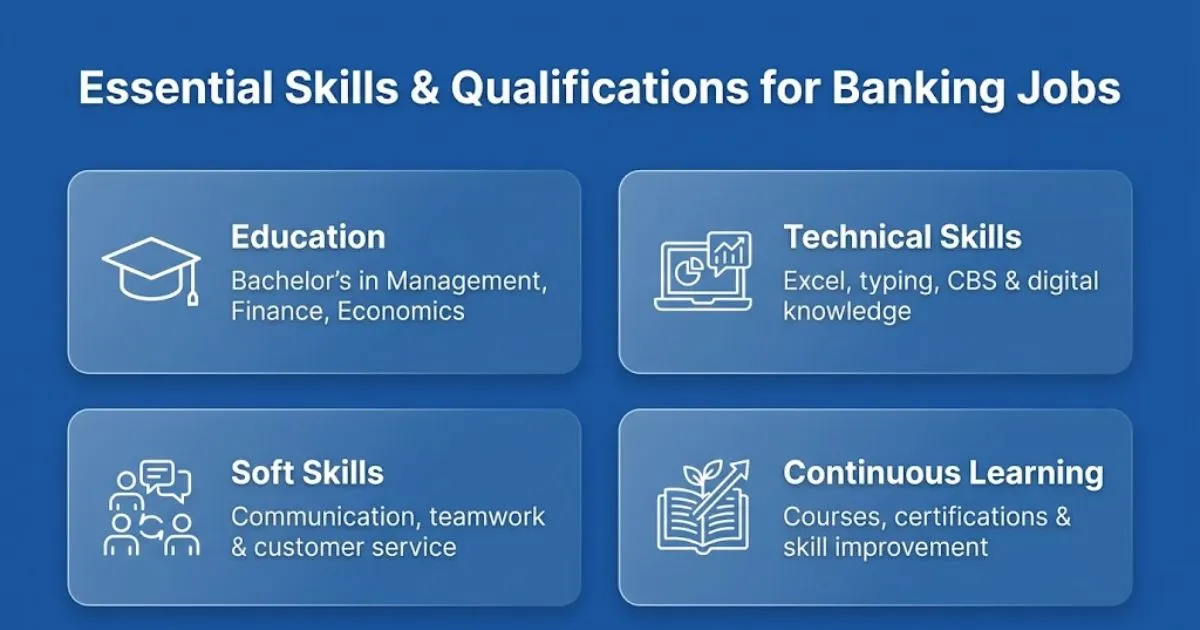
If you want to start a banking job in Nepal, you need the right education and basic skills. Most banks look for candidates with a Bachelor’s degree in Management, Finance, Business, or Economics. Along with education, computer skills and good communication are also important. Banking is a competitive field, so having the right skills helps you get a job and grow in your career step by step.
1. Academic Requirements and Certificates
To get a job in a bank in Nepal, most banks ask for at least a Bachelor’s degree. The degree should be in Management, Business, Finance, or Economics. Banks also look at your grades, and usually, a GPA of 2.5 or above, or at least 50% marks, is needed. For entry-level jobs, there is often an age limit. Most banks prefer candidates who are under 25 to 28 years old. Having the right education and certificates is the first step to starting a career in banking.
2. Technical Skills You Need
Banks look for candidates who have basic computer skills. Knowing Microsoft Excel well is very important because it is used in daily banking work. Typing skills in both Nepali and English are often checked, so being fast and accurate helps. Knowing Core Banking Software (CBS), which is the system banks use to manage accounts and transactions, is a big advantage. Digital skills like data analysis, online banking, or cybersecurity knowledge are also helpful. Having these technical skills makes you stand out among other candidates.
3. Soft Skills That Help You Succeed
Besides education and technical skills, banks also want employees with good soft skills. Communication is very important because you will talk to customers every day. Customer service skills help you solve problems politely and professionally. Banks also value honesty and integrity, as trust is very important in finance. Being adaptable and able to work well in a team is also crucial because banks require teamwork to complete tasks efficiently. These skills are essential to grow and do well in a banking career.
4. Keep Learning and Improving
Banks love employees who keep learning and improving. Taking extra courses or certifications, like those offered by the Banking, Finance, and Insurance Institute of Nepal (BFIN), shows that you are serious about your career. Learning new skills, keeping up with banking rules, and understanding digital tools will help you grow faster and prepare you for higher positions. Continuous learning is an important part of building a successful and long-term career in banking.
Career Progression and future growth in Banking Sector
A banking career in Nepal usually starts with entry-level jobs like Trainee Assistant or Junior Assistant. After gaining some experience, you can move to roles like Assistant, Supervisor, and Officer. With more experience and good work performance, you can become a Manager or even higher. Your growth depends on how well you do your job, your skills, and sometimes exams inside the bank. If you keep learning and working hard, you can get promoted faster and build a strong career in banking.
Bank jobs in Nepal also offer good salary growth over time. Beginners can earn around NPR 20,000 to 35,000 per month. Officer-level jobs pay around NPR 45,000 to 70,000, and managers can earn more than NPR 100,000 per month. Along with salary, banks provide extra benefits like Dashain bonus, provident fund, medical insurance, and staff loans at low interest rates. Many banks, like Sanima Bank, also provide training programs and support for higher studies like MBA. This helps you learn new skills, grow in your career, and build a secure future.
Conclusion: Why Choose a Banking Career in Nepal?
Banking jobs in Nepal are a great career choice because they offer job security, respect, and growth opportunities. You can build skills, get promotions, and work in cities like Kathmandu, Pokhara, or Biratnagar, as well as in microfinance institutions in smaller areas.
The banking sector is growing quickly with digital banking and new technologies, creating more job opportunities. It offers good salaries, bonuses, training, and other benefits. Overall, a banking career provides stability, career growth, and a chance to contribute to the country’s development.