


DSA (Data Structures and Algorithms) is a way of organizing data and solving problems efficiently in programming. It is not a job title but an important skill that helps you qualify for roles such as Software Developer, Backend Developer, and other software engineering positions.
In this guide, you'll learn what DSA jobs are, which IT roles require DSA, the skills employers expect, software developer salary in Nepal, current demand for DSA skills, and practical tips to help you get hired.
DSA Related Jobs in Nepal
There is no job called "DSA job." DSA is a skill used inside common roles like Software Developer or Backend Developer. You will see DSA listed inside the requirements or interview process, not as the job title itself.
Below are the roles where DSA knowledge is commonly useful in Nepal's software industry.
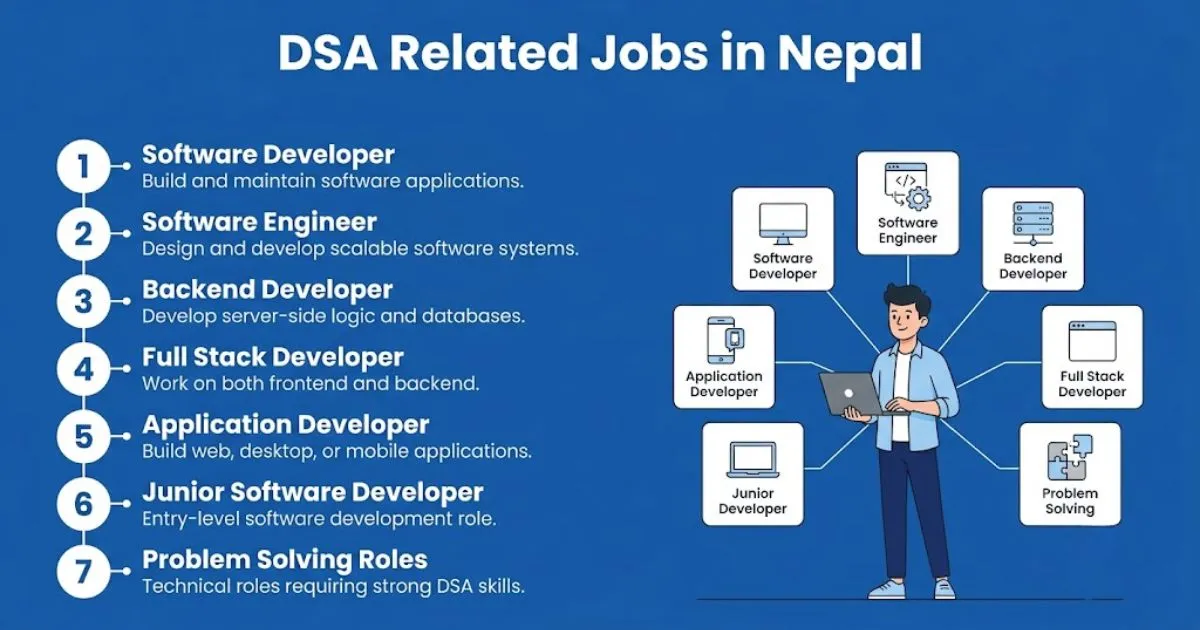
1. Software Developer
This is the most common job for CS graduates in Nepal. You write, test, and fix code for apps and systems. DSA helps because you often need to search, sort, or handle data efficiently. You also need to know a programming language well and use tools like Git. Most companies in Nepal, whether they build products or work for foreign clients, hire for this title, so it is a good role to target early in your career.
2. Software Engineer
Similar to a software developer but with more focus on system design and solving bigger technical problems. Companies that hire for this role, especially product based companies, often test DSA seriously in interviews. This title is also used for people who work on larger systems, so employers may expect you to think about performance and scale, not just write working code.
3. Backend Developer
Backend developers build the server side of an app, meaning the part that handles data and logic. DSA matters a lot here since backend systems deal with large amounts of data. You also need to know databases and APIs well. As Nepali companies build more apps that handle real user traffic and data, this role has become one of the more technically demanding ones for DSA preparation.
4. Full Stack Developer
Full stack developers work on both the frontend (what users see) and backend (server logic). DSA is mainly useful for the backend part. For frontend work, UI skills and JavaScript frameworks matter more. This role is common in smaller Nepali companies and startups, where one developer often handles both sides of the application.
5. Application Developer
This role focuses on building web, desktop, or mobile apps. DSA helps write efficient logic, but knowing the specific platform or framework matters just as much. If you are targeting mobile app roles in Nepal, expect employers to check platform experience alongside basic DSA understanding.
6. Junior Software Developer
For entry level roles, companies usually check basic programming and DSA knowledge, not advanced skills. They want to see if you can think clearly and learn fast. This is often the actual title used for fresher hiring in Nepal, even when the job description looks similar to a regular software developer role.
7. Competitive Programming / Problem Solving Roles
A few companies, mostly product based or tech focused ones, value strong problem solving backgrounds. This is not common everywhere in Nepal, but it can be a plus point. If you have a competitive programming background, mention it on your resume since it can stand out during screening, even for roles that are not purely algorithm focused.
In every role above, DSA is only one part of what employers look for. No company hires someone based on DSA alone.
Skills Required for DSA Jobs
You do not need to master everything in DSA. You need to understand the basics well enough to use them in real problems. Employers usually test a mix of core data structures, basic algorithms, and your general problem solving approach. Below is a simple breakdown of what is commonly expected, grouped by topic.
Core Data Structures
These form the foundation of most interview questions and real coding work.
- Arrays and Strings: The starting point for most problems, used for handling and checking data.
- Linked Lists: Show how data can connect without fixed size.
- Stacks and Queues: Useful for order based and sequence based problems.
Advanced Data Structures
These come up more in mid level and senior interviews, and in real backend systems.
- Hashing: Very practical for fast lookups, common in real backend work.
- Trees: Useful for hierarchical data like folders or organization charts.
- Graphs: Useful for connected data like maps or networks.
Algorithms and Techniques
These help you actually solve problems using the structures above.
- Recursion: Solving a problem using smaller versions of the same problem.
- Sorting and Searching: Arranging and finding data efficiently.
- Common Techniques: Methods like two pointers or sliding window, mostly seen in mid level and senior interviews.
Complexity and Problem Solving
This is less about memorizing and more about how you think.
- Time and Space Complexity: Understanding how fast your code runs and how much memory it uses.
- Basic Problem Solving: Breaking a problem down and building a clear, working solution.
How to Find DSA Jobs in Nepal
Once you have the basic skills, the next step is knowing where to actually look. Most DSA related jobs in Nepal are posted on job portals, LinkedIn, or shared directly through company pages and community groups. Below are the main places most developers use to find these jobs.
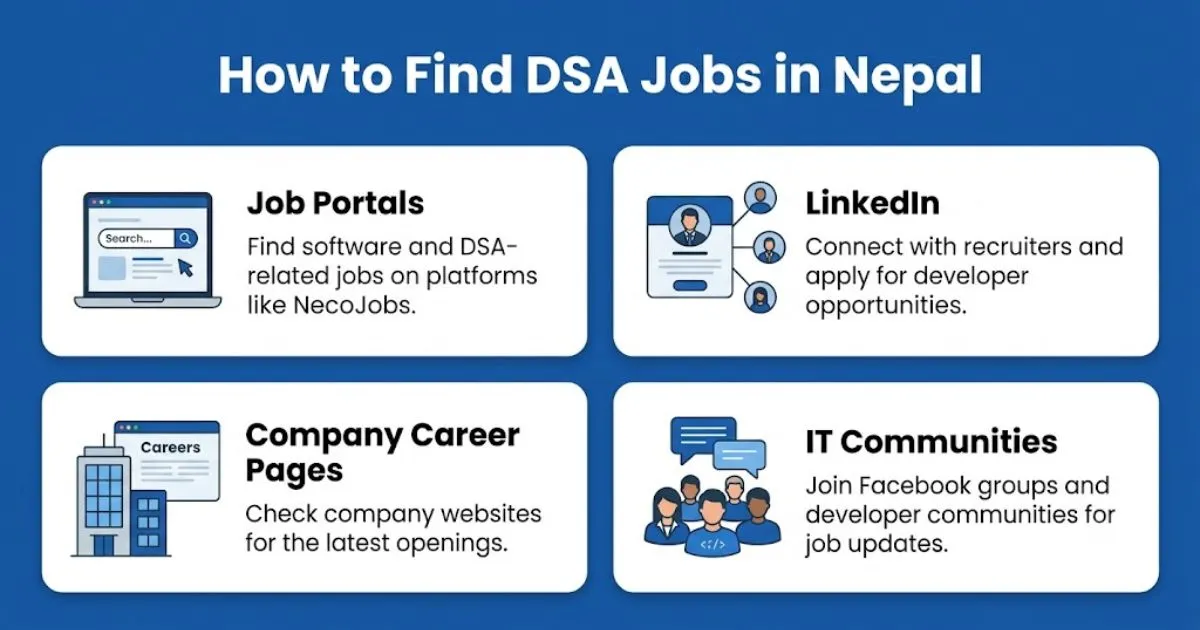
1. Job Portals
Job portals are the most common starting point for developers in Nepal. Site like Necojobs list a wide range of IT jobs, including software developer, backend developer, and other DSA related roles, updated regularly by companies of different sizes. Checking these portals often, and setting up alerts for relevant keywords, can help you catch new postings early.
2. LinkedIn
LinkedIn is widely used by IT companies and recruiters in Nepal to post jobs and reach candidates directly. Many recruiters also search LinkedIn profiles actively, so keeping your profile updated with your skills and projects can help you get noticed even without applying first.
3. Company Career Pages
Many software companies in Nepal, especially larger and more established ones, post openings directly on their own website before listing them anywhere else. If you already have a few target companies in mind, checking their career pages regularly is worth the extra effort.
4. IT Facebook Groups and Communities
Several active Facebook groups in Nepal share job openings from smaller and mid sized companies, often faster than formal job portals. These groups can also be useful for asking questions, getting referrals, or learning about companies that are actively hiring.
Salary of DSA Related Jobs in Nepal
DSA itself has no salary. Pay depends on the job role and experience level, not on DSA knowledge alone. The ranges below are based on figures commonly reported by Nepali job platforms and salary tracking sites. Actual pay still depends on the company, technology, location, and your performance during hiring.
Internship
Most internships in Nepal are the first step into the industry. Internships usually pay between NPR 10,000 and 20,000 per month. At this stage, the goal is mainly learning and building real experience, not high pay.
Entry Level / Fresher
After completing an internship, freshers who move into a full-time role as an Associate Developer or Junior Developer typically earn around NPR 25,000 to NPR 45,000 per month. At smaller local firms, entry-level pay tends to sit a bit lower, closer to NPR 20,000 to 30,000, while more established or reputable companies in Kathmandu may offer around NPR 35,000 to 50,000.
Mid Level
Developers with around 2-5 years of experience usually move into mid-level positions, with salaries generally ranging from NPR 50,000 to 90,000 per month, depending on the company and the developer's skills. Full-stack and backend focused developers with strong practical skills can sometimes earn toward the higher end of this range or beyond, depending on the company and project.
Senior Level
Senior developers in Nepal with 5+ years of experience typically earn NPR 100,000+ per month, with salaries varying based on the company, role, and specialization. Experienced professionals working at larger companies or multinational organizations can earn significantly more. At this stage, salary depends less on DSA skills and more on system design expertise, technical leadership, architecture knowledge, and overall industry experience.
Demand for DSA Skills in Nepal
DSA demand in Nepal is real, but it is not the same across every company or role. Employers want people who can think logically and solve problems efficiently, and DSA is one clear way to show that ability during hiring. That said, how much weight a company gives to DSA usually depends on what kind of business it runs and what the specific role actually needs.
- Product based companies: Companies building their own software products tend to test DSA more seriously, since their systems often need to handle scale and performance over time.
- Startups: Startups often look for people who can solve problems independently with limited resources, so problem solving ability, including DSA, tends to matter here too.
- Service based or outsourcing companies: Many companies working on client projects focus more on practical development skills and specific tools needed for the job, though this still varies by company and role.
- Backend and software engineering roles: DSA tends to matter more here, since these roles often involve handling data and building systems that need to run efficiently.
- Frontend, QA, and UI/UX roles: DSA is usually less central here, with UI skills, testing methods, or design tools carrying more weight in hiring.
DSA is steadily becoming a bigger part of hiring in Nepal, as more companies add coding rounds and problem solving questions to their interview process. It is best to treat DSA as one strong skill among several that employers look for, with its actual importance depending on the specific role and company type.
DSA vs Practical Development Skills
DSA and practical skills serve different purposes.
Many students in Nepal spend most of their time only on DSA and end up with no real projects or portfolio. This is a mistake. A balance of DSA and hands on project work makes you a much stronger candidate.
Is DSA Necessary for IT Jobs in Nepal?
DSA is useful for many software jobs in Nepal, but it is not equally necessary for every IT job. How much you need depends heavily on the specific role and the type of company you are applying to, so it helps to look at where DSA plays a bigger part and where it does not.
- Roles where DSA matters most: Software engineer, backend developer, and roles at product based companies usually involve stronger DSA expectations, since coding rounds are common in their hiring process.
- Roles where basic DSA is often enough: Frontend developer, QA, UI/UX, and many service based positions tend to focus more on practical, tool based interviews rather than heavy algorithm testing.
- The best way to decide: Read the job description carefully. If it mentions coding rounds, problem solving, or technical assessments, prioritize DSA preparation. If it focuses on specific tools and frameworks instead, spend more time building practical, hands-on skills.
How to Prepare for DSA Jobs
Preparing for a DSA related job works best when you follow a clear order, rather than jumping straight into solving random problems. Here is a simple path most successful candidates in Nepal tend to follow.
- Programming Basics: Learn one language well first. Variables, loops, functions, and logic.
- DSA Fundamentals: Learn core structures step by step. Focus on understanding, not memorizing.
- Problem Solving: Apply what you learned to real problems and understand patterns.
- Practice: Practice regularly. Understanding matters more than the number of problems solved.
- Projects: Build real projects using your skills. This shows employers you can build actual software.
- Interview Preparation: Practice explaining your solution out loud and writing clean code under time pressure.
- Job Applications: Apply once you have reasonable preparation. You do not need to be perfect first.
- Keep Improving: Learn from rejections and interview feedback, keep practicing, and keep applying. Most developers land their first job after a few attempts, not the first one.
Conclusion
DSA is not a separate job in Nepal, but it is an important skill for software developers. If you want to become a software developer, backend developer, or work at a product-based company, learning DSA can help you perform better in coding interviews and write more efficient code.
However, DSA alone is not enough to get hired. You also need to build real projects, improve your development skills, and communicate your ideas clearly during interviews. Keep practicing consistently, work on practical projects, and start applying for jobs as you learn instead of waiting until you feel completely ready.