


In Nepal, companies are no longer just collecting data they are actually using it to make smarter decisions. From banks to startups and IT industries every business now depends on people who can understand numbers and turn them into useful insights.
That is exactly why data analyst jobs are growing fast in Nepal. It has become one of the most talked about careers among students and job seekers who want to enter the tech field.
In this guide we will cover what a data analyst does, how much they earn in Nepal, what skills you need and how you can start a career in this field.
Table of Contents
- Understanding the Data Analyst Role in Nepal
- What Does a Data Analyst Do?
- Steps in Data Analysis
- Industries That Hire Data Analysts in Nepal
- Data Analyst Salary in Nepal
- Entry-Level Data Analyst Salary (0–2 Years)
- Mid-Level Data Analyst Salary (2–5 Years)
- Senior Data Analyst Salary (5+ Years)
- Factors Affecting Data Analyst Salary in Nepal
- 1. Experience Level
- 2. Skills and Tools
- 3. Industry
- 4. Location
- 5. Company Type
- Skills and Education Required for Data Analyst in Nepal
- Technical Skills
- Soft Skills
- Education and Learning Path
- Data Analyst Career Path in Nepal
- 1. Starting a Career in Data Analysis
- 2. Growing in the Data Analyst Role
- 3. Senior Roles and Career Change Options
- Future Scope for Data Analysts in Nepal
- Conclusion
Understanding the Data Analyst Role in Nepal
What Does a Data Analyst Do?
A data analyst works with data to help a company understand what is happening in its business. In Nepal, a data analyst collects information, checks it carefully, and studies it to find useful details. They often make reports, charts, and dashboards to show results. This work helps companies decide things like how much to charge for products, how to reach customers, and how to improve daily work. Because these decisions are important, data analysts play a key role in many organizations.
Steps in Data Analysis
The work of a data analyst is done step by step. First, data is collected from places like company records, surveys, websites, or mobile apps. Next, the data is cleaned by fixing mistakes and removing wrong or missing information. After that, the analyst studies the data using tools such as Excel, SQL, or Python to understand patterns and changes. In the final step, the findings are shown using tables, charts, or dashboards so that managers and other team members can understand the results easily.
Industries That Hire Data Analysts in Nepal
Many types of organizations in Nepal hire data analysts. IT and software companies are the biggest employers. Banks and fintech companies use data analysts to track money and customer activity. Telecom companies and online shopping platforms use data to improve their services. NGOs and development organizations also need data analysts for planning and reports. Today, digital marketing, healthcare, and education sectors are also using data analysts to make better plans and decisions.
Data Analyst Salary in Nepal
Entry-Level Data Analyst Salary (0–2 Years)
Entry-level data analysts in Nepal usually earn between NPR 30,000 to NPR 50,000 per month. These are freshers or beginners who are just starting their careers in data analysis. Their main work includes collecting data, cleaning it, and preparing simple reports. At this stage, they focus on learning basic tools like Excel and SQL while building a strong foundation in data analysis.
Mid-Level Data Analyst Salary (2–5 Years)
Mid-level data analysts in Nepal earn around NPR 50,000 to NPR 120,000 per month. After gaining a few years of experience, they start working with larger datasets and perform more detailed analysis. They also create dashboards and reports that help companies make better decisions. At this level, they are expected to know tools like SQL, Power BI, Tableau, and sometimes Python.
Senior Data Analyst Salary (5+ Years)
Senior data analysts in Nepal can earn NPR 120,000 to NPR 250,000 or more per month. These professionals have strong experience and handle complex data tasks. They often lead projects, guide junior team members, and support business planning. They use advanced tools like Python or R to analyze data and provide insights that help companies grow and make important decisions.
Factors Affecting Data Analyst Salary in Nepal
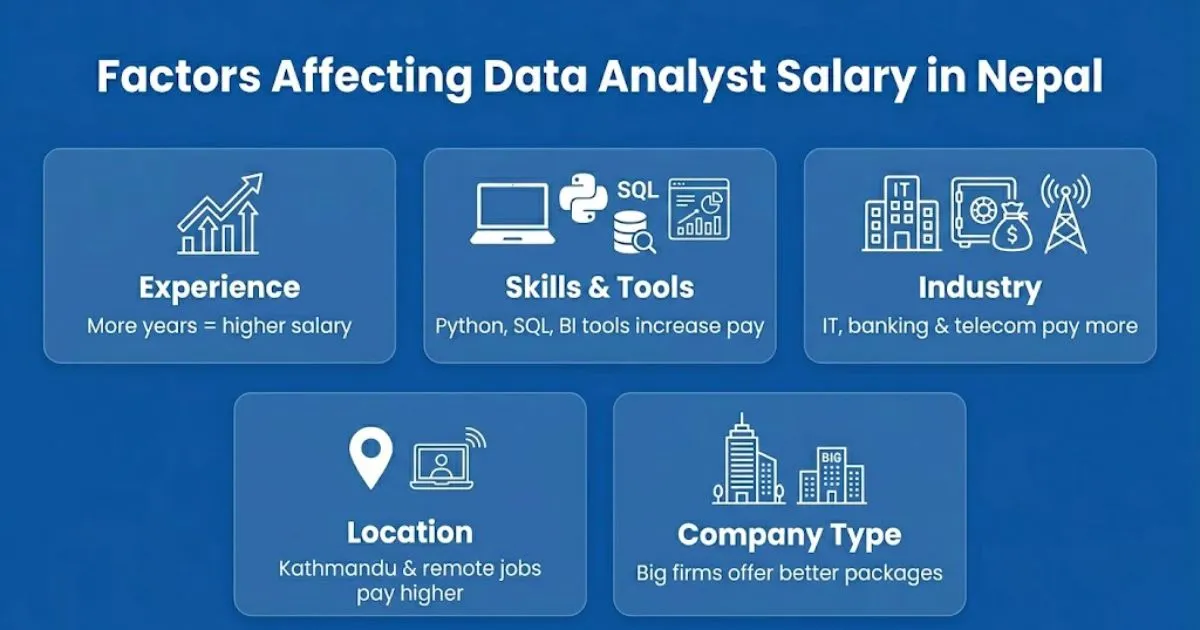
The salary of a data analyst in Nepal depends on several important factors that decide how much you can earn in this field. These factors include experience, skills, industry, location, company type, and remote job opportunities. When you understand these clearly, it becomes easier to plan your career and improve your salary step by step.
1. Experience Level
Experience is one of the biggest reasons for salary difference in this field. Freshers or entry-level data analysts usually earn less because they are new and still learning the basics. After working for 2 to 3 years, they move to mid-level roles where they handle more work and earn a better salary. Senior data analysts with 5 or more years of experience earn the highest salary because they work on complex tasks, lead projects, and help companies make important decisions.
2. Skills and Tools
Your skills also decide how much salary you can get. At the beginning, most people use basic tools like Excel and SQL. But if you want a higher salary, you need to learn more advanced tools like Power BI, Tableau, and Python. Skills like data cleaning, making reports, and creating charts are very important in daily work. The better your skills, the more value you bring to a company, and the higher your salary becomes.
3. Industry
The type of industry you work in also affects your salary. IT and software companies in Nepal usually pay the highest salaries because they depend heavily on data. Banks, fintech companies, and telecom companies also offer good salaries and stable jobs. E-commerce companies use data analysts to understand customers and improve sales. NGOs and social organizations may offer lower salaries, but they often provide steady and long-term work.
4. Location
Location also plays a role in salary differences. Data analysts working in Kathmandu usually earn more because most companies and offices are based there. In other cities, salaries may be lower due to fewer job opportunities. However, remote work is slowly removing this difference, and people from any location can now apply for better-paying jobs.
5. Company Type
The company you work for also matters a lot. Big and well-known companies usually pay higher salaries and offer extra benefits like bonuses, insurance, and training. Startups and small companies may pay less at the beginning, but they give more learning opportunities and faster growth, which can help you increase your salary in the future.
Skills and Education Required for Data Analyst in Nepal
To become a data analyst in Nepal, you need a good mix of technical skills, soft skills, and the right learning path. Companies prefer people who can work with data tools, understand information, and also explain results that helps in decision-making.
Technical Skills
Technical skills are the most important part of a data analyst job. These are the tools you use every day to work with data.
- Excel: Used for organizing data, making reports, and doing basic analysis work in most companies.
- SQL: Used to collect data from databases and manage large amounts of data easily.
- Python: Used for data analysis and working with large datasets using tools like Pandas.
- R Programming: Used for statistical analysis and deeper data study.
- Power BI: Used to create dashboards and reports that help businesses understand data quickly.
- Tableau: Used to make charts and visual reports to present data.
- Statistics: Helps you understand trends, patterns, averages, and relationships in data.
These skills are very important because they help you do real job work. The better your technical skills, the better your job opportunities and salary.
Soft Skills
Soft skills are also very important because data analysis is not only about tools, but also about how you communicate and think.
- Communication Skills: Helps you explain data results in a clear and easy way to others.
- Problem-Solving Skills: Helps you find answers from data when problems come up.
- Attention to Detail: Helps you avoid mistakes when working with data.
- Critical Thinking: Helps you understand what the data is really saying.
- Teamwork: Helps you work well with other teams like marketing, finance, and operations.
These skills matter a lot because companies want analysts who can explain insights clearly, not just prepare reports.
Education and Learning Path
Many data analysts in Nepal come from backgrounds like IT, computer science, mathematics, statistics, or engineering. But a degree alone is not enough in most cases. Most people learn data analysis through online courses, certifications, and training programs.
Short bootcamps are also helpful for learning faster and gaining practical skills. Working on real projects is very important because it helps you build experience and a strong portfolio. Since tools and technology keep changing, you also need to keep learning regularly to stay updated and get better job opportunities in the future.
Data Analyst Career Path in Nepal
1. Starting a Career in Data Analysis
Most people in Nepal start their data analyst career with beginner-level roles. These roles are often called data intern, data assistant, or junior data analyst. In these positions, people learn how to collect information, check data for mistakes, and prepare reports. They also practice using tools like Excel and basic charts. Internships are very helpful for students because they provide real work experience and help them understand how data is used in offices. These early roles help build a strong base for a data analyst career.
2. Growing in the Data Analyst Role
After gaining some work experience, data analysts move to higher positions. At this stage, they work with more data and handle more important tasks. Many analysts start to focus on one area, such as business data, marketing data, or finance data. They may also help new team members and explain data results to managers. With better skills and experience, data analysts get higher salaries and more responsibility in their jobs.
3. Senior Roles and Career Change Options
With many years of experience, data analysts can move into senior roles. Senior data analysts work on big projects and help companies make long-term plans. Some professionals also change their career path and move into roles like data scientist, analytics manager, product analyst, or business intelligence lead. These roles involve leadership, planning, and decision-making. They also offer higher pay and strong career growth in Nepal’s data and technology field.
Future Scope for Data Analysts in Nepal
In Nepal, many companies are using computers and the internet more than before. Because of this, they collect a lot of information about their work, customers, and services. To understand this information, they need data analysts. This is why data analyst jobs in Nepal are increasing every year. IT companies, banks, online shopping companies, telecom offices, hospitals, schools, and NGOs are all hiring data analysts. This shows that data analysis is a job with good future demand in Nepal.
New technology is also creating more job chances for data analysts. Companies use new tools to handle large amounts of data, but they still need people to read the data and explain. To find jobs in Nepal, data analysts can use job websites, LinkedIn, and company pages. Meeting people in the same field also helps. While more people are learning data analysis, those who keep improving their skills can get good jobs and build a long and stable career in Nepal.
Conclusion
A career in data analysis offers a strong and positive future in Nepal. Many companies now use data to understand their work, improve services, and make better decisions. Because of this, the demand for data analysts is increasing across many sectors. With the right skills, basic experience, and continuous learning, you can earn a good salary and grow step by step in this field. If you keep improving your knowledge and learning new tools, you can build a stable and rewarding career as a data analyst in Nepal or even work for international companies in the future.